
Hawker Typhoon
Fighter-bomber · Hawker Aircraft · United Kingdom
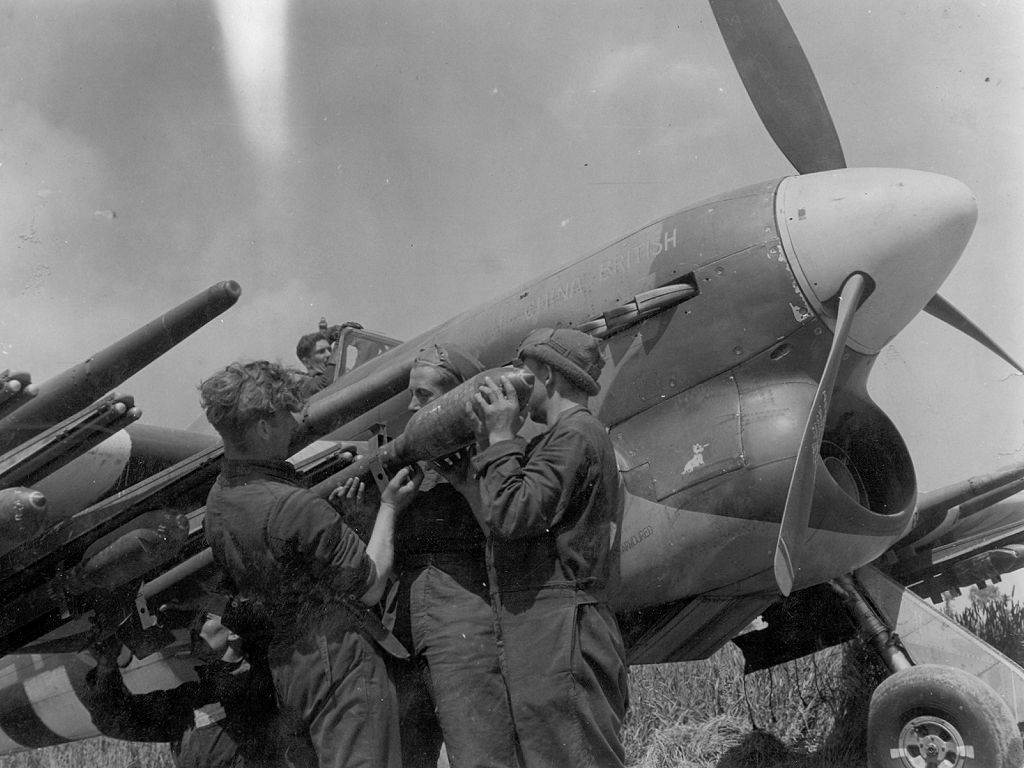
ⓘ licence & credit
Public domain, via Wikimedia Commons — https://commons.wikimedia.org/wiki/File:Royal_Air_Force_(RAF)_Hawker_Typhoon_being_re-armed_in_July_1944_on_a_forward_airfield_in_France_during_Operation_Overlord.jpg| Typical crew | 1 |
|---|---|
| Engines | 1 × Napier Sabre |
| First flight | 1940 |
| Number built | 3,317 |
Photographs
ⓘ licence & credit
Lea T (Plt Off), Royal Air Force official photographer / Public domain, via Wikimedia Commons — https://commons.wikimedia.org/wiki/File:Hawker_Typhoon_-_Eindhoven_-_Royal_Air_Force-_2nd_Tactical_Air_Force,_1943-1945._CL1441.jpgView source & full licence →ⓘ licence & credit
Unknown authorUnknown author / Public domain, via Wikimedia Commons — https://commons.wikimedia.org/wiki/File:Gun_camera_footage_of_a_Hawker_Typhoon_shooting_down_a_Focke-Wulf_Fw_190.jpgView source & full licence →ⓘ licence & credit
Author unknown. RCAF photographer. / Public domain, via Wikimedia Commons — https://commons.wikimedia.org/wiki/File:Eindhoven_October_1944_Typhoon_MN816_438_SQN.jpgView source & full licence →ⓘ licence & credit
Clark N S (Flt Lt) Royal Air Force official photographer / Public domain, via Wikimedia Commons — https://commons.wikimedia.org/wiki/File:Cricket_at_B5-Le_Fresne_IWM_CL_407.jpgView source & full licence →ⓘ licence & credit
Royal Air Force official photographer; Original uploader was Skinny87 at en.wikipedia / Public domain, via Wikimedia Commons — https://commons.wikimedia.org/wiki/File:Bombcarpiquet.jpgView source & full licence →ⓘ licence & credit
Stanley Devon / Public domain, via Wikimedia Commons — https://commons.wikimedia.org/wiki/File:A_Hawker_Typhoon_Mk_IB_of_No._486_Squadron_RAF,_27_October_1943._CH11578.jpgView source & full licence →ⓘ licence & credit
Miller (Pilot Officer), Royal Air Force official photographer / Public domain, via Wikimedia Commons — https://commons.wikimedia.org/wiki/File:609_Squadron_RAF_Typhoon_Manston_IWM_CH_9822.jpgView source & full licence →ⓘ licence & credit
Royal Air Force official / Public domain, via Wikimedia Commons — https://commons.wikimedia.org/wiki/File:56_Sqn-1.jpgView source & full licence →ⓘ licence & credit
Royal Air Force (RAF) official / Public domain, via Wikimedia Commons — https://commons.wikimedia.org/wiki/File:56_Sqn_score.jpgView source & full licence →ⓘ licence & credit
Unknown authorUnknown author / Public domain, via Wikimedia Commons — https://commons.wikimedia.org/wiki/File:438_SQN_RCAF_Hawker_Typhoons_prep_for_take_off.jpgView source & full licence →ⓘ licence & credit
assumed British Government / Public domain, via Wikimedia Commons — https://commons.wikimedia.org/wiki/File:3_in_RP_60_pdr_Loading_On_Typhoon.jpgView source & full licence →ⓘ licence & credit
San Diego Air & Space Museum Archives / Public domain, via Wikimedia Commons — https://commons.wikimedia.org/wiki/File:15_Hawker_TyphoonJX-X_(15650912917).jpgView source & full licence →ⓘ licence & credit
San Diego Air & Space Museum Archives / Public domain, via Wikimedia Commons — https://commons.wikimedia.org/wiki/File:15_Hawker_Typhoon_R9831,_EL-U_(15216077124).jpgView source & full licence →ⓘ licence & credit
San Diego Air & Space Museum Archives / Public domain, via Wikimedia Commons — https://commons.wikimedia.org/wiki/File:15_Hawker_Typhoon_P5216_(15216625763).jpgView source & full licence →ⓘ licence & credit
San Diego Air & Space Museum Archives / Public domain, via Wikimedia Commons — https://commons.wikimedia.org/wiki/File:15_Hawker_Typhoon_(15837610252).jpgView source & full licence →About
The Hawker Typhoon began as a disappointment and ended as one of the most feared aircraft over the Normandy battlefield. Sydney Camm designed it as a powerful successor to the Hawker Hurricane, but its big Napier Sabre engine was troublesome and its early service in 1941 was dogged by structural and reliability problems that nearly saw it cancelled.
Its salvation came at low altitude. The Typhoon was the one RAF fighter that could catch the Focke-Wulf Fw 190 at the heights at which the Germans were making nuisance raids, and from there it grew into a devastating ground-attack machine. Armed with four 20 mm cannon and, from 1943, eight rockets, the “Tiffy” became the backbone of the Second Tactical Air Force’s strike squadrons. Crews earned fame as “train busters”, and after D-Day Typhoons hammered German armour and transport, most infamously in the Falaise pocket. Around 3,200 were built.
Sources: This page was compiled from publicly available historical sources, including Hawker Typhoon — BAE Systems Heritage and Hawker Typhoon — Wikipedia. The text is original and has been written from factual source material; no source text has been copied unless specifically quoted and attributed.
Engines
- Napier Sabre — 24-cylinder liquid-cooled sleeve-valve H-block