
Republic Thunderbolt
Fighter · Republic Aviation · United States
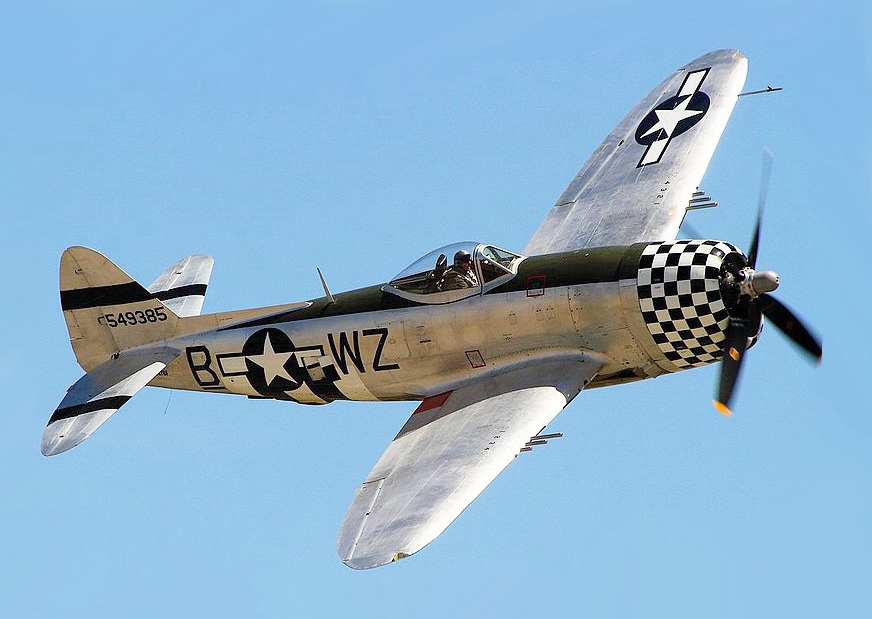
ⓘ licence & credit
Tim Felce / CC BY-SA 2.0, via Wikimedia Commons — https://commons.wikimedia.org/wiki/File:P47_Thunderbolt_-_Chino_2014_(cropped).jpg| Typical crew | 1 |
|---|---|
| Engines | 1 × Pratt & Whitney Double Wasp |
| First flight | 1941 |
| Number built | 15,636 |
Photographs
ⓘ licence & credit
assumed USAAF / Public domain, via Wikimedia Commons — https://commons.wikimedia.org/wiki/File:359th_Fighter_Group_P-47_Thunderbolts.jpgView source & full licence →ⓘ licence & credit
Unknown authorUnknown author / Public domain, via Wikimedia Commons — https://commons.wikimedia.org/wiki/File:359th_Fighter_Group_-_P-47_Thunderbolts.jpgView source & full licence →ⓘ licence & credit
assumed USAAF / Public domain, via Wikimedia Commons — https://commons.wikimedia.org/wiki/File:358fg-p47-hhalden.jpgView source & full licence →ⓘ licence & credit
United States Army Air Forces / Public domain, via Wikimedia Commons — https://commons.wikimedia.org/wiki/File:356th_Fighter_Group_-_P-47_Thunderbolt_42-74702_at_RAF_Goxhill.jpgView source & full licence →ⓘ licence & credit
United States Army Air Force / Public domain, via Wikimedia Commons — https://commons.wikimedia.org/wiki/File:355fg-p47-wwii.jpgView source & full licence →ⓘ licence & credit
United States Army Air Force / Public domain, via Wikimedia Commons — https://commons.wikimedia.org/wiki/File:353dfg-p-47-thunderbolt.jpgView source & full licence →ⓘ licence & credit
assumed USAAF / Public domain, via Wikimedia Commons — https://commons.wikimedia.org/wiki/File:352fg-p47.jpgView source & full licence →ⓘ licence & credit
United States Air Force / Public domain, via Wikimedia Commons — https://commons.wikimedia.org/wiki/File:351stFS-P-47-1943.pngView source & full licence →ⓘ licence & credit
United States Army Air Forces / Public domain, via Wikimedia Commons — https://commons.wikimedia.org/wiki/File:345th_Fighter_Squadron_-_P-47_Thunderbolts.jpgView source & full licence →ⓘ licence & credit
United States Army Air Force / Public domain, via Wikimedia Commons — https://commons.wikimedia.org/wiki/File:325fightergroup-p-47-1943.jpgView source & full licence →ⓘ licence & credit
United States Army Air Forces / Public domain, via Wikimedia Commons — https://commons.wikimedia.org/wiki/File:318th_Fighter_Group_P-47_Thunderbolts_East_Field_Saipan_1944.jpgView source & full licence →ⓘ licence & credit
United States Army Air Forces / Public domain, via Wikimedia Commons — https://commons.wikimedia.org/wiki/File:1st_Air_Commando_Group_-_P-47_Thunderbolts.jpgView source & full licence →ⓘ licence & credit
emailer / CC BY-SA 2.0, via Wikimedia Commons — https://commons.wikimedia.org/wiki/File:1DA9DE4_UL.jpgView source & full licence →ⓘ licence & credit
United States Air Force / Public domain, via Wikimedia Commons — https://commons.wikimedia.org/wiki/File:128th_Fighter_Squadron_P-47_Thunderbolt_Marietta_GA_May_1946.jpgView source & full licence →ⓘ licence & credit
United States National Guard / Public domain, via Wikimedia Commons — https://commons.wikimedia.org/wiki/File:104th_Fighter_Squadron_-_P-47_Thunderbolts_1947.jpgView source & full licence →ⓘ licence & credit
Royal Navy official photographer / Public domain, via Wikimedia Commons — https://commons.wikimedia.org/wiki/File:Thunderbolt_II_30_Sqn_RAF_at_Jumchar_1945.jpgView source & full licence →About
The Republic Thunderbolt was the largest and heaviest single-engined fighter of the war, and in RAF hands it was a Far Eastern weapon. Britain received some 830 of these massive Pratt & Whitney-engined fighters — the RAF was the type’s second-largest operator — and sent them all to South East Asia Command for the campaign in Burma.
From 1944 sixteen RAF squadrons flew Thunderbolts against the Japanese, where the type’s ruggedness, heavy eight-gun armament, bomb load and long range made it an ideal ground-attack aircraft to replace the Hawker Hurricane in the theatre. Operating in “cab rank” patrols directed by ground controllers, RAF Thunderbolts struck Japanese troops, transport and supply lines in close support of the advancing Fourteenth Army. Early “razorback” aircraft served as the Thunderbolt I and later bubble-canopy machines as the Thunderbolt II.
Sources: This page was compiled from publicly available historical sources, including Republic P-47D Thunderbolt II — RAF Museum and Republic P-47 Thunderbolt in RAF Service — historyofwar.org. The text is original and has been written from factual source material; no source text has been copied unless specifically quoted and attributed.