
Gloster Meteor
Fighter · Gloster Aircraft Company · United Kingdom
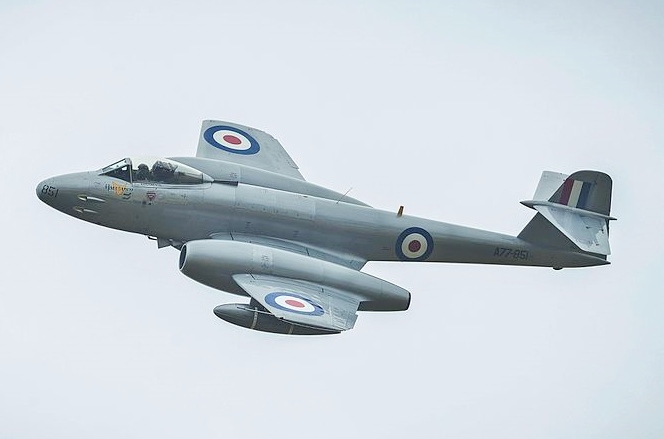
ⓘ licence & credit
Chris Phutully / CC BY 2.0, via Wikimedia Commons — https://commons.wikimedia.org/wiki/File:Gloster_Meteor_Centenary_of_Military_Aviation_2014_(cropped).jpg| Typical crew | 1 |
|---|---|
| Engines | 2 × Rolls-Royce Welland/Derwent (jet) |
| First flight | 1943 |
| Number built | 3,947 |
Photographs
ⓘ licence & credit
Gloster Aircraft Company / Public domain, via Wikimedia Commons — https://commons.wikimedia.org/wiki/File:Gloster_Meteor_poster_June_1950.jpgView source & full licence →ⓘ licence & credit
Glostermeteorc010 / CC BY-SA 4.0, via Wikimedia Commons — https://commons.wikimedia.org/wiki/File:Gloster_Meteor_C-010_Expo_2023_IMPA_TRQ.jpgView source & full licence →ⓘ licence & credit
Andrew Arch from Melbourne, Australia / CC BY-SA 2.0, via Wikimedia Commons — https://commons.wikimedia.org/wiki/File:Gloster_Meteor_(5600785654).jpgView source & full licence →ⓘ licence & credit
John5199 / CC BY 2.0, via Wikimedia Commons — https://commons.wikimedia.org/wiki/File:Duxford_Jubilee_Airshow_2012_(7296283894)_(2).jpgView source & full licence →ⓘ licence & credit
Anthony Parkes / CC BY-SA 2.0, via Wikimedia Commons — https://commons.wikimedia.org/wiki/File:Crash_Wreckage_of_Gloster_Meteor_Aircraft_-_geograph.org.uk_-_2710382.jpgView source & full licence →ⓘ licence & credit
Philip Halling / CC BY-SA 2.0, via Wikimedia Commons — https://commons.wikimedia.org/wiki/File:Armstrong_Whitworth_Meteor_-_geograph.org.uk_-_6303561.jpgView source & full licence →ⓘ licence & credit
Philip Halling / CC BY-SA 2.0, via Wikimedia Commons — https://commons.wikimedia.org/wiki/File:Armstrong_Whitworth_Meteor_-_geograph.org.uk_-_6303556.jpgView source & full licence →ⓘ licence & credit
André Cros / CC BY-SA 4.0, via Wikimedia Commons — https://commons.wikimedia.org/wiki/File:23.02.69_Concorde_roule_et_l%C3%A8ve_le_nez_(1969)_-_53Fi1851.jpgView source & full licence →ⓘ licence & credit
Alex Elena / CC BY-SA 2.0, via Wikimedia Commons — https://commons.wikimedia.org/wiki/File:20130831-Airshow2013-320_(9824918604).jpgView source & full licence →ⓘ licence & credit
Air Historical Branch-RAF / OGL v1.0, via Wikimedia Commons — https://commons.wikimedia.org/wiki/File:100_years_of_the_RAF_MOD_45163617.jpgView source & full licence →About
The Gloster Meteor was Britain’s first operational jet aircraft and the only Allied jet to see combat in the Second World War. It grew from the pioneering turbojet work of Frank Whittle’s Power Jets, married to a conventional twin-engined Gloster airframe; the prototype flew in 1943 and the first Meteors reached No. 616 Squadron in July 1944.
The Meteor’s combat debut was against the V-1 flying bomb. The pulse-jet “doodlebugs” flew too fast for many piston fighters to catch, but the jet-powered Meteor could run them down, destroying over a dozen — in one celebrated case by tipping a V-1’s wing to topple it, after the fighter’s cannon jammed. Late in the war Meteors moved to the Continent. With four 20 mm cannon and steady development, the type went on to form the backbone of post-war RAF Fighter Command, with nearly 4,000 built.
Sources: This page was compiled from publicly available historical sources, including Gloster Meteor — Wikipedia and Jet legends: the Gloster Meteor — Forces News. The text is original and has been written from factual source material; no source text has been copied unless specifically quoted and attributed.
Engines
- Rolls-Royce Welland — Centrifugal-flow turbojet