

- Died
- 16 July 1942, aged 25
- Fate
- Killed in action
Biography
William Riley was born in 1917 in Manorhamilton, County Leitrim, in the Irish Republic, the son of Reverend John Riley and Catherine Riley. He joined the Royal Air Force on a short service commission in August 1935 and spent his early career with 54 Squadron at Hornchurch and a posting to RAF Far East headquarters in Singapore, giving him considerable flying experience before the war. When hostilities began he flew Gladiators with 263 Squadron during the Norwegian campaign in May 1940, claiming two Heinkel He 111s destroyed, and later served with 302 (Polish) Squadron and 145 Squadron during the Battle of Britain, building a combat record that included Ju 88s, a Messerschmitt Bf 109 and a Junkers Ju 87 destroyed or probably destroyed. He subsequently moved to Coastal Command, flying with 252 and then 272 Squadrons in the Middle East, where further victories — including a Focke-Wulf Fw 200 Condor and shared destruction of an Italian SM.81 transport — led to the award of the Distinguished Flying Cross, gazetted on 28 October 1941. Promoted to Wing Commander, he was attached to 272 Squadron in Egypt in April 1942 in preparation for taking command of the newly forming 227 Squadron on Malta. He was killed on 16 July 1942, aged twenty-five, when his Bristol Beaufighter collided with another aircraft shortly after takeoff; his body was not recovered, and he is commemorated on the Alamein Memorial, Column 247, Egypt.
Last updated 4 June 2026.
Burial / commemoration
- Cemetery
- Alamein Memorial, Egypt
Timeline
-
28 October 1941
Gazetted: DFC
Distinguished Flying Cross -
16 July 1942
Died
aged 25
Awards
-
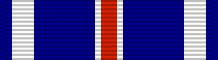 Distinguished Flying Cross (DFC) — gazetted 28 October 1941