
Douglas Boston
Light bomber · Douglas Aircraft · United States
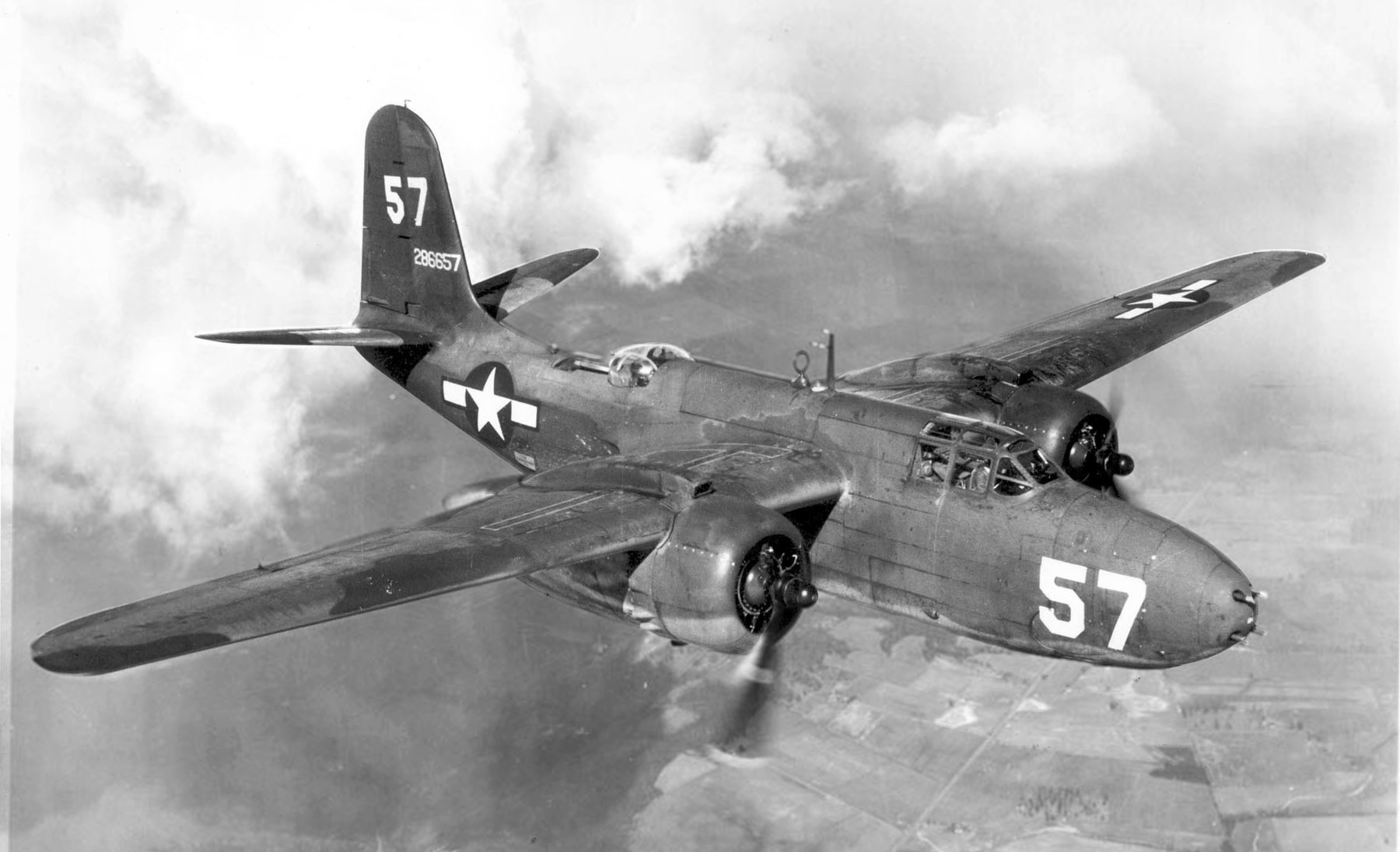
ⓘ licence & credit
USAAF (via Wikimedia Commons, Public domain)| Typical crew | 3 |
|---|---|
| Engines | 2 × Wright Cyclone |
| First flight | 1938 |
| Number built | 7,478 |
Photographs
ⓘ licence & credit
AFHRA / Public domain, via Wikimedia Commons — https://commons.wikimedia.org/wiki/File:A-20.jpgView source & full licence →ⓘ licence & credit
Public domain, via Wikimedia Commons — https://commons.wikimedia.org/wiki/File:A-20_Boston_in_flight_.75_right.jpgView source & full licence →ⓘ licence & credit
USAAF / Public domain, via Wikimedia Commons — https://commons.wikimedia.org/wiki/File:A-20_attacking_Lae_airfield_with_G4M_c1943.jpgView source & full licence →ⓘ licence & credit
Office of Scientific Research and Development / Public domain, via Wikimedia Commons — https://commons.wikimedia.org/wiki/File:9th_Air_Force_Havocs_with_Pathfinder_Radar.jpgView source & full licence →ⓘ licence & credit
US Army Air Forces photograph / Public domain, via Wikimedia Commons — https://commons.wikimedia.org/wiki/File:674BombSqCombatCrews.PNGView source & full licence →ⓘ licence & credit
United States Army Air Forces / Public domain, via Wikimedia Commons — https://commons.wikimedia.org/wiki/File:646th_Bombardment_Squadron_-_A-20_Havocs.jpgView source & full licence →ⓘ licence & credit
United States Army Air Forces / Public domain, via Wikimedia Commons — https://commons.wikimedia.org/wiki/File:646th_Bombardment_Squadron_-_A-20_Havoc.jpgView source & full licence →ⓘ licence & credit
United States Air Force / Public domain, via Wikimedia Commons — https://commons.wikimedia.org/wiki/File:645th_Bombardment_Squadron_-_A-20_Havoc.jpgView source & full licence →ⓘ licence & credit
United States Army Air Forces / Public domain, via Wikimedia Commons — https://commons.wikimedia.org/wiki/File:59th_Bombardment_Squadron_Douglas_A-20A_Havoc_40-0093.jpgView source & full licence →ⓘ licence & credit
United States Army Air Forces / Public domain, via Wikimedia Commons — https://commons.wikimedia.org/wiki/File:495th_Fighter_Training_Group_-_A-20_Havocs_in_Flight.jpgView source & full licence →ⓘ licence & credit
United States Army Air Forces / Public domain, via Wikimedia Commons — https://commons.wikimedia.org/wiki/File:422d_Night_Fighter_Squadron_Douglas_A-20_Havoc.jpgView source & full licence →ⓘ licence & credit
US Army Air Forces photographs / Public domain, via Wikimedia Commons — https://commons.wikimedia.org/wiki/File:417BombGpA-20formation.PNGView source & full licence →ⓘ licence & credit
United States Army Air Force / Public domain, via Wikimedia Commons — https://commons.wikimedia.org/wiki/File:416thbg-a20flight.jpgView source & full licence →ⓘ licence & credit
United States Army Air Force / Public domain, via Wikimedia Commons — https://commons.wikimedia.org/wiki/File:416thbg-a20-d-day.jpgView source & full licence →ⓘ licence & credit
United States Army Air Force / Public domain, via Wikimedia Commons — https://commons.wikimedia.org/wiki/File:410bg-a20formation.jpgView source & full licence →ⓘ licence & credit
Public domain, via Wikimedia Commons — https://commons.wikimedia.org/wiki/File:8AFHQ-boston3-bovington.jpgView source & full licence →ⓘ licence & credit
US Air Force / Public domain, via Wikimedia Commons — https://commons.wikimedia.org/wiki/File:89th_Bomb_Squadron_A-20.jpgView source & full licence →ⓘ licence & credit
Stanley Scott Collection / Public domain, via Wikimedia Commons — https://commons.wikimedia.org/wiki/File:181_Airplanes_in_field_-_USACE-p15141coll5-9407.jpegView source & full licence →ⓘ licence & credit
United States Army Air Forces / Public domain, via Wikimedia Commons — https://commons.wikimedia.org/wiki/File:155th_Photo_Reconnaissance_Squadron_Douglas_A-20J-15-DO_Havoc_(F-3A)_43-21731.jpgView source & full licence →About
The Douglas Boston was the British name for the bomber versions of the American DB-7 family, the night-fighter and intruder variants being known as the Havoc. A fast, tricycle-undercarriage twin powered by two Wright Cyclone radials, it came to the RAF from 1941 and re-equipped the day-bomber squadrons of No. 2 Group, replacing the Bristol Blenheim.
As a Boston III the type flew low- and medium-level daylight raids over occupied Europe — airfields, power stations, docks and shipping — often behind a fighter escort. As the Havoc it served as a radar night fighter and intruder, and in one of the war’s odder experiments some carried the “Turbinlite”, a huge nose searchlight intended to illuminate enemy bombers for accompanying fighters. Roughly two dozen RAF squadrons flew the type, valued for its speed, sturdiness and pleasant handling.
Sources: This page was compiled from publicly available historical sources, including A-20 Havoc Medium Bomber — World War II Database and Douglas A-20 Havoc — Wikipedia. The text is original and has been written from factual source material; no source text has been copied unless specifically quoted and attributed.