
Bristol Blenheim
Light bomber · Bristol Aeroplane Company · United Kingdom
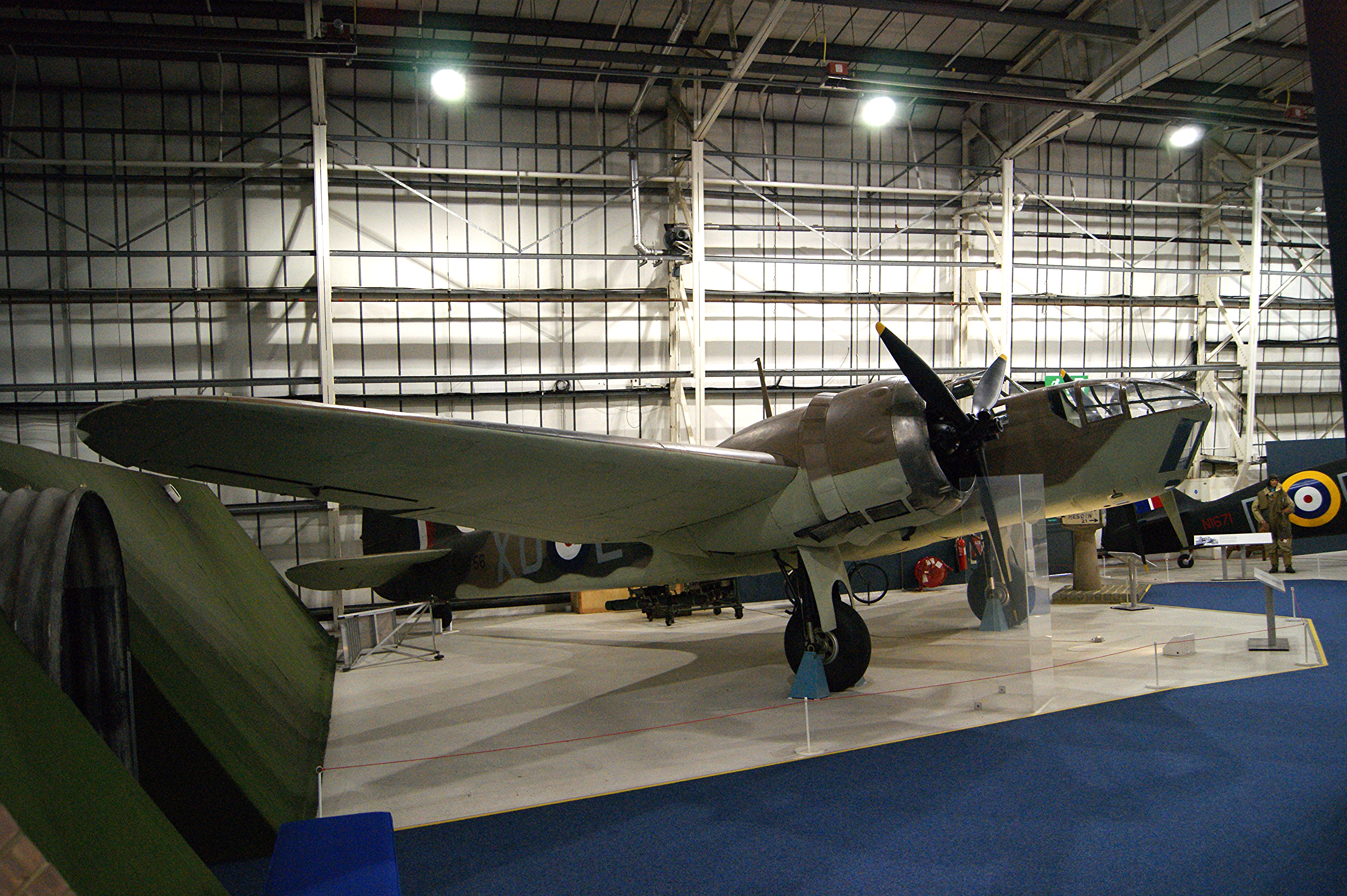
ⓘ licence & credit
Hugh Llewelyn from Keynsham, UK / CC BY-SA 2.0, via Wikimedia Commons — https://commons.wikimedia.org/wiki/File:Bristol_Bolingbroke_IV-Blenheim_IV_(21630744589).jpg| Typical crew | 3 |
|---|---|
| Engines | 2 × Bristol Mercury |
| First flight | 1936 |
| Number built | 4,422 |
Photographs
ⓘ licence & credit
Royal Air Force official photographer / Public domain, via Wikimedia Commons — https://commons.wikimedia.org/wiki/File:Royal_Air_Force_Operations_in_the_Middle_East_and_North_Africa,_1939-1943._CM1500.jpgView source & full licence →ⓘ licence & credit
Royal Air Force official photographer / Public domain, via Wikimedia Commons — https://commons.wikimedia.org/wiki/File:Royal_Air_Force_Operations_in_the_Far_East,_1941-1945._CI253.jpgView source & full licence →ⓘ licence & credit
Daventry B J (F/O), Royal Air Force official photographer / Public domain, via Wikimedia Commons — https://commons.wikimedia.org/wiki/File:Royal_Air_Force_1939-1945-_Bomber_Command_CH777.jpgView source & full licence →ⓘ licence & credit
Royal Air Force official photographer / Public domain, via Wikimedia Commons — https://commons.wikimedia.org/wiki/File:Royal_Air_Force_1939-1945-_Bomber_Command_C2039.jpgView source & full licence →ⓘ licence & credit
Unknown authorUnknown author / Public domain, via Wikimedia Commons — https://commons.wikimedia.org/wiki/File:PMR79-781_8_Sqn_RCAF_Bolinbroke_1942.jpgView source & full licence →ⓘ licence & credit
Unknown authorUnknown author / Public domain, via Wikimedia Commons — https://commons.wikimedia.org/wiki/File:PMR79-762_Bolinbroke_of_115_Sqn_RCAF.jpgView source & full licence →ⓘ licence & credit
Screenshot / Public domain, via Wikimedia Commons — https://commons.wikimedia.org/wiki/File:Lightship_attack.jpgView source & full licence →ⓘ licence & credit
Eric Jones / CC BY-SA 2.0, via Wikimedia Commons — https://commons.wikimedia.org/wiki/File:Close_to_the_point_of_impact_of_the_Bristol_Blenheim_V6099_on_Elidir_Fawr_-_geograph.org.uk_-_6744572.jpgView source & full licence →ⓘ licence & credit
www.mgaylard.co.uk and thanks for looking / CC BY 2.0, via Wikimedia Commons — https://commons.wikimedia.org/wiki/File:Bristol_Blenheim_MK.IF_-_Imperial_War_Museum_Duxford.jpgView source & full licence →ⓘ licence & credit
Ad Meskens You are free to use this picture for any purpose as long as you credit its author, Ad Meskens. Example: © Ad Meskens / Wikimedia Commons If you use this work outside of the Wikimedia projects, a message or a copy is very much appreciated. This image is not in the public domain. A staView source & full licence →ⓘ licence & credit
Municipal Archives of Trondheim from Trondheim, Norway / CC BY 2.0, via Wikimedia Commons — https://commons.wikimedia.org/wiki/File:Bristol_Blenheim_Air_Crash_-_Bristol_Blenheim_Flystyrt_(1941)_(4170966495).jpgView source & full licence →ⓘ licence & credit
neznámý (unknown) / Public domain, via Wikimedia Commons — https://commons.wikimedia.org/wiki/File:Bristol_Blenheim_(motor_Merkur_IX).jpgView source & full licence →ⓘ licence & credit
Australian War Memorial / Public domain, via Wikimedia Commons — https://commons.wikimedia.org/wiki/File:Blenheims_flying_low.jpgView source & full licence →ⓘ licence & credit
Australian armed forces / Public domain, via Wikimedia Commons — https://commons.wikimedia.org/wiki/File:Blenheims_60_Sqn_off_Akyab_1942.jpgView source & full licence →ⓘ licence & credit
Photograph No. 107 Squadron RAF / Public domain, via Wikimedia Commons — https://commons.wikimedia.org/wiki/File:Basil_Embry_over_burning_British_tanker.jpgView source & full licence →ⓘ licence & credit
MKFI / Public domain, via Wikimedia Commons — https://commons.wikimedia.org/wiki/File:A.M._T1082_R1083_radio_Bristol_Blenheim.JPGView source & full licence →ⓘ licence & credit
Unknown authorUnknown author / Public domain, via Wikimedia Commons — https://commons.wikimedia.org/wiki/File:30_mm_mine_shell_test.pngView source & full licence →ⓘ licence & credit
WFan / CC BY-SA 4.0, via Wikimedia Commons — https://commons.wikimedia.org/wiki/File:20191117_Bristol_bomber_cabin.jpgView source & full licence →ⓘ licence & credit
Royal Air Force / Public domain, via Wikimedia Commons — https://commons.wikimedia.org/wiki/File:11_Squadron_RAF_Blenheims_bombing_Beirut_1941_IWM_HU_93073.jpgView source & full licence →About
The Bristol Blenheim began life as a civil aircraft. Newspaper proprietor Lord Rothermere commissioned Bristol to build a fast private transport, and the resulting Type 142 proved quicker than the RAF’s fighters of the day — a performance that prompted the Air Ministry to order a bomber version straight off the drawing board. It entered service in 1937 as one of the first stressed-skin, retractable-undercarriage monoplanes in the RAF.
Powered by two Bristol Mercury radials and crewed by three, the Blenheim was fast for the mid-1930s but soon outpaced by enemy fighters. Its crews paid a heavy price flying daylight anti-shipping and low-level raids over occupied Europe in 1940–41, where casualties were severe. The type also served as one of the RAF’s first radar-equipped night fighters before being supplanted by the Bristol Beaufighter. It remains a symbol of the costly early daylight bombing campaign.
Sources: This page was compiled from publicly available historical sources, including Bristol Blenheim IV — RAF Museum and Bristol Blenheim — Wikipedia. The text is original and has been written from factual source material; no source text has been copied unless specifically quoted and attributed.
Engines
- Bristol Mercury — 9-cylinder single-row air-cooled radial
Airframes in this database
| Serial | Code | Squadron | Fate |
|---|---|---|---|
| BA875 | W | — | Lost on operations |
| N6215 | — | 139 | Unknown |
| V6028 | GB-D | 105 | Unknown |