
Boeing Flying Fortress
Heavy bomber · Boeing · United States
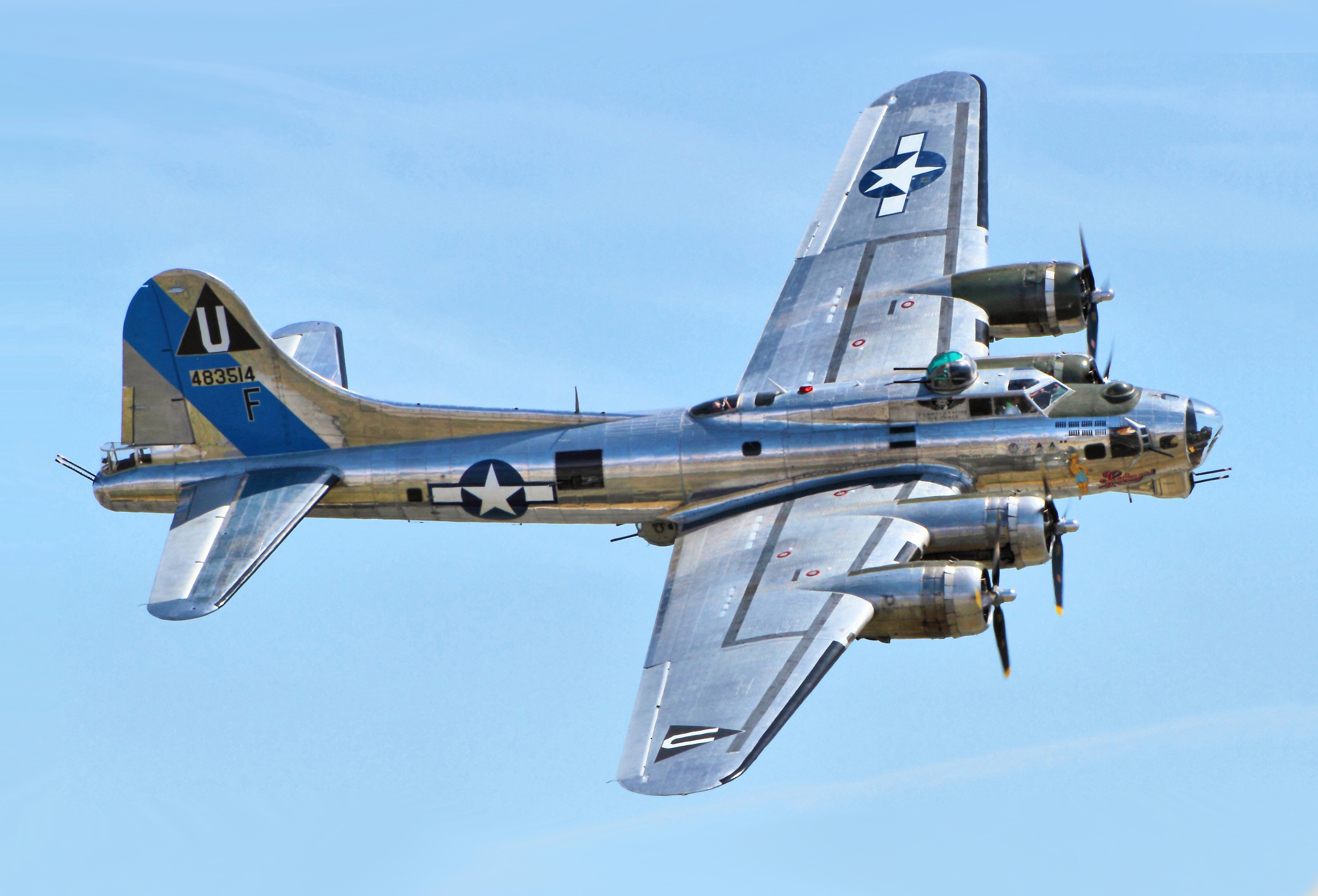
ⓘ licence & credit
Airwolfhound / CC BY-SA 2.0, via Wikimedia Commons — https://commons.wikimedia.org/wiki/File:B17_-_Chino_Airshow_2014_(framed).jpg| Typical crew | 10 |
|---|---|
| Engines | 4 × Wright Cyclone |
| First flight | 1935 |
| Number built | 12,731 |
Photographs
ⓘ licence & credit
Thomas Vogt from Paderborn, Deutschland / CC BY 4.0, via Wikimedia Commons — https://commons.wikimedia.org/wiki/File:B-17_Flying_Fortress_-_Flickr_-_Triple-green.jpgView source & full licence →ⓘ licence & credit
U.S. Forest Service / Public domain, via Wikimedia Commons — https://commons.wikimedia.org/wiki/File:B-17_fire_retardant_drop.JPGView source & full licence →ⓘ licence & credit
Orange County Archives from Orange County, California, United States of America / CC BY 4.0, via Wikimedia Commons — https://commons.wikimedia.org/wiki/File:B-17_bomber,_biplanes,_and_other_aircraft_at_Orange_County_Airport,_circa_1950s_-_Flickr_-_Orange_County_Archives.jpgView source & full licence →ⓘ licence & credit
Pi3.124 / CC BY-SA 4.0, via Wikimedia Commons — https://commons.wikimedia.org/wiki/File:Automatic_Radio_Direction_Finder_R-5_ARN7_radio_control_box.jpgView source & full licence →ⓘ licence & credit
John Makkinje, Brett Langevat, Daifallah Annah and Dalfaallah Annah / Public domain, via Wikimedia Commons — https://commons.wikimedia.org/wiki/File:Aerial_Survey_aircraft_at_Qaisumah_1956_by_John_Makkinje_Brett_Langevat_Daifallah_Annah_Dalfaallah_Annah_5791067689.jpgView source & full licence →ⓘ licence & credit
CC BY-SA 4.0, via Wikimedia Commons — https://commons.wikimedia.org/wiki/File:A_B-17_tail.jpgView source & full licence →ⓘ licence & credit
United States Army Air Force / Public domain, via Wikimedia Commons — https://commons.wikimedia.org/wiki/File:43d_bomb_group_b-17s_New_Guinea_1942.jpgView source & full licence →ⓘ licence & credit
AnonymousUnknown author / Public domain, via Wikimedia Commons — https://commons.wikimedia.org/wiki/File:342-FH_000856.jpgView source & full licence →ⓘ licence & credit
United States Army Air Corps / Public domain, via Wikimedia Commons — https://commons.wikimedia.org/wiki/File:19th_Bomb_Group_B-17_Australia_1942.jpgView source & full licence →ⓘ licence & credit
R6, State & Private Forestry, Forest Health Protection / Public domain, via Wikimedia Commons — https://commons.wikimedia.org/wiki/File:1955._Crewman_fills_chemical_tank_on_B-17._Spruce_budworm_control_project._Bitterroot_National_Forest,_Montana._(33175065670).jpgView source & full licence →ⓘ licence & credit
RFlackAttack / CC BY-SA 4.0, via Wikimedia Commons — https://commons.wikimedia.org/wiki/File:1942-07-06_First_97th_BG_B-17s_to_Arrive_at_their_Assigned_RAF_Base_in_England_LS_View.jpgView source & full licence →ⓘ licence & credit
Clifford Bottomley / Public domain, via Wikimedia Commons — https://commons.wikimedia.org/wiki/File:105mm_howitzer_unloaded_near_Buna-Gona_front.jpgView source & full licence →ⓘ licence & credit
Joshbaumgartner / Public domain, via Wikimedia Commons — https://commons.wikimedia.org/wiki/File:World_operators_of_the_B-17.pngView source & full licence →ⓘ licence & credit
Joshbaumgartner / Public domain, via Wikimedia Commons — https://commons.wikimedia.org/wiki/File:Civil_operators_of_the_B-17.pngView source & full licence →ⓘ licence & credit
Tangopaso / CC BY-SA 3.0, via Wikimedia Commons — https://commons.wikimedia.org/wiki/File:Marks_and_letters_on_the_tails_of_B-17_during_WWII_in_Europe.jpgView source & full licence →About
The Boeing B-17 Flying Fortress is best known as the mainstay of the United States Army Air Forces’ daylight bombing of Germany, but it also served in RAF colours. Britain received early B-17C models in 1941 as the Fortress I and tried them on high-altitude daylight raids over Europe; the experiment went badly, exposing the type’s defensive weaknesses in that role before the later, better-armed marks the Americans flew.
The RAF’s lasting use of the Fortress was at sea. Transferred to Coastal Command, the Fortress II and IIA flew long-range anti-submarine patrols over the Atlantic, and in October 1942 a Fortress of No. 206 Squadron sank U-627 — the first of eleven U-boat kills credited to RAF Fortresses. As Consolidated Liberators took over the patrol role, the Fortress moved to meteorological reconnaissance, flying weather sorties from Iceland, Scotland and England.
Sources: This page was compiled from publicly available historical sources, including Boeing B-17 Flying Fortress in RAF service — historyofwar.org and Boeing B-17 Flying Fortress — Wikipedia. The text is original and has been written from factual source material; no source text has been copied unless specifically quoted and attributed.