
RAF Angle
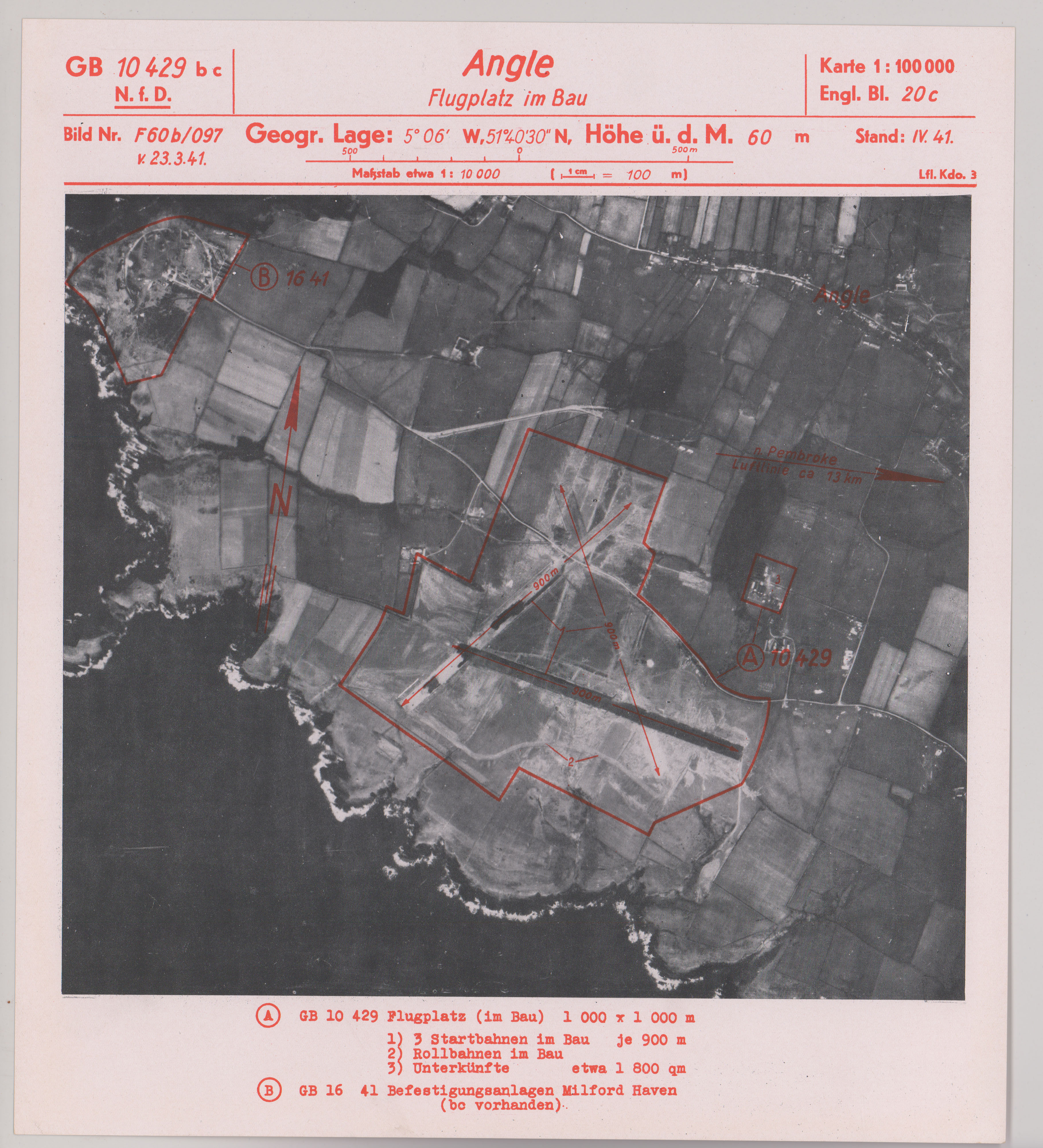
ⓘ licence & credit
Germany. Luftwaffe / Public domain, via Wikimedia Commons — https://commons.wikimedia.org/wiki/File:Target_Dossier_for_Angle,_Pembrokeshire,_Wales_-_DPLA_-_7e0a8fe065a26e53586fa340e1263045_(page_1).jpgAbout
RAF Angle opened on 1 June 1941 on the windswept Angle peninsula of Pembrokeshire, some eight miles west of Pembroke in south-west Wales. It began life as a forward fighter airfield, first under Fighter Command’s No. 10 Group, guarding the western approaches and the shipping lanes of the Bristol Channel and Irish Sea. A succession of single-engined fighter squadrons passed through, among them No. 32 and No. 615 Squadrons flying Hawker Hurricanes, No. 312 (Czechoslovak) and No. 152 Squadrons with Supermarine Spitfires, the Canadian Nos. 412 and 421 Squadrons, and No. 263 Squadron operating the unusual twin-engined Westland Whirlwind.
From 1943 the station’s character shifted decisively towards the sea. Control passed for a period to the Royal Navy, and Fleet Air Arm units such as 794 and 759 Naval Air Squadrons used the field for target-towing and advanced training. It also came under Coastal Command’s No. 19 Group, supporting anti-submarine and maritime trials work, including equipment and radar development flying. A Short Sunderland flying boat famously made an emergency landing on the runway here on 29 May 1943.
The airfield wound down after the war, passing to Army control before final closure in 1946. The site afterwards reverted largely to farmland, and today only faint traces of the wartime landing ground survive.
Sources: This page was compiled from publicly available historical sources, including Airfields of Britain Conservation Trust — Angle and Wikipedia: RAF Angle. The text is original and has been written from factual source material; no source text has been copied unless specifically quoted and attributed.
No people are cross-referenced to this airfield yet. Links appear as squadron postings, crews and service records are added.