
Short Sunderland
Maritime patrol · Short Brothers · United Kingdom
ⓘ licence & credit
(via Wikimedia Commons, Public domain)| Typical crew | 11 |
|---|---|
| Engines | 4 × Bristol Pegasus or Pratt & Whitney Twin Wasp |
| First flight | 1937 |
| Number built | 777 |
Photographs
ⓘ licence & credit
Royal Air Force official photographer, Gale (Plt Off) / Public domain, via Wikimedia Commons — https://commons.wikimedia.org/wiki/File:95_Squadron_RAF_Sunderland_at_Freetown_WWII_IWM_CM_2564-83-36.jpgView source & full licence →ⓘ licence & credit
Royal Air Force official photographer, Gale (Plt Off) / Public domain, via Wikimedia Commons — https://commons.wikimedia.org/wiki/File:95_Squadron_RAF_Sunderland_at_Freetown_WWII_IWM_CM_2564-83-23.jpgView source & full licence →ⓘ licence & credit
Hensser H (Mr), Royal Air Force official photographer / Public domain, via Wikimedia Commons — https://commons.wikimedia.org/wiki/File:230_Squadron_RAF_Sunderland_Greece_WWII_IWM_CM_294.jpgView source & full licence →ⓘ licence & credit
Steve Knight from Halstead, United Kingdom / CC BY 2.0, via Wikimedia Commons — https://commons.wikimedia.org/wiki/File:201_Squadron_RAF_Short_Sunderland_Mk.5_SZ576_moored_on_the_River_Thames_in_the_Pool_of_London_with_The_Tower_of_London_behind._(27404448583).jpgView source & full licence →About
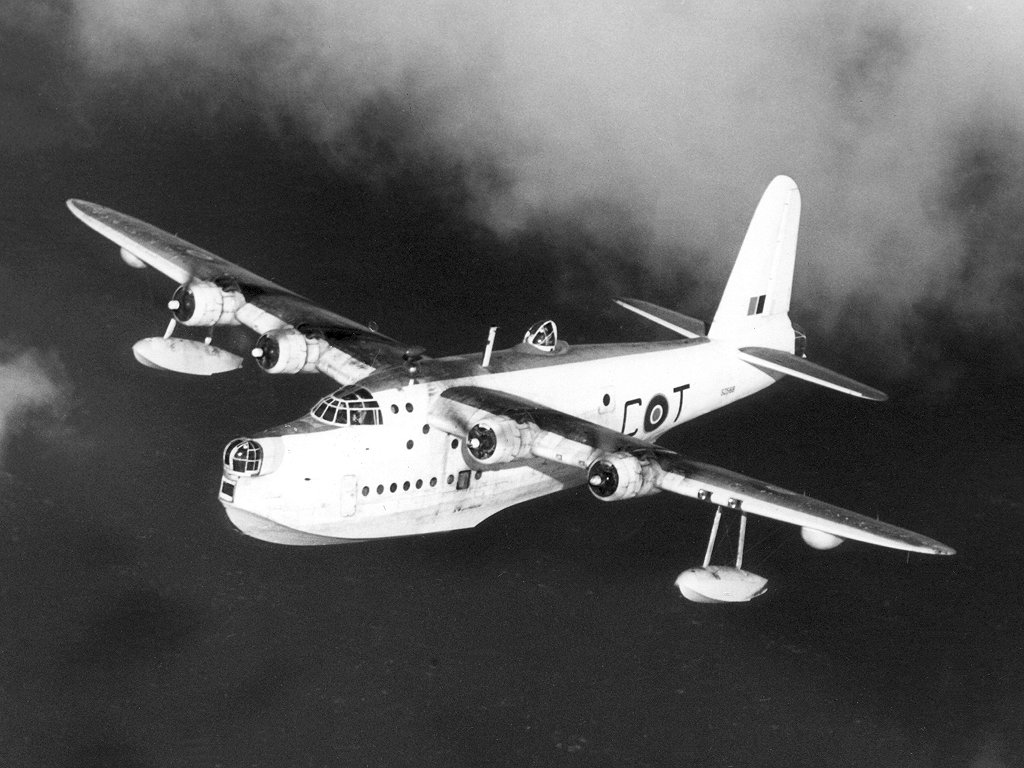
The Short Sunderland was the RAF’s great maritime flying boat of the war, named after the north-east shipbuilding port. Developed from Short Brothers’ Empire airliners to a 1933 requirement for a long-range patrol boat, it first flew in 1937 and reached Coastal Command in 1938; some forty were in service by the outbreak of war.
A four-engined boat with a deep, two-step hull, the Sunderland carried a large crew on patrols that could last many hours, and bristled with defensive guns — German aircrew reputedly dubbed it the “Flying Porcupine”. Fitted with ASV radar, depth charges and the Leigh light, it became one of Coastal Command’s principal U-boat hunters in the Battle of the Atlantic, working alongside the Consolidated Catalina and very-long-range Consolidated Liberator. It also rescued survivors and ferried passengers, and remained in RAF service until 1959, with nearly 780 built.
Sources: This page was compiled from publicly available historical sources, including Short Sunderland MR5 — RAF Museum and Short Sunderland — Wikipedia. The text is original and has been written from factual source material; no source text has been copied unless specifically quoted and attributed.
Engines
- Bristol Pegasus — 9-cylinder single-row air-cooled radial