
RAF Bardney
England — County: Lincolnshire
ⓘ licence & credit
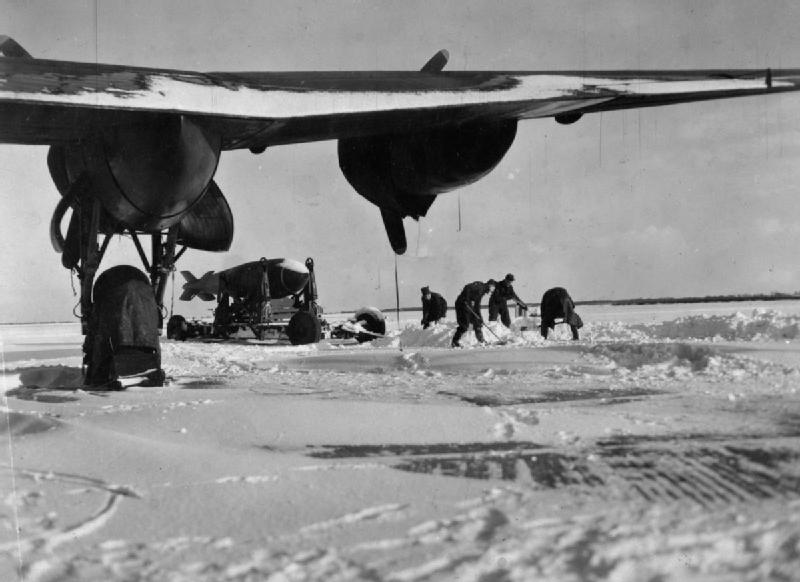
Royal Air Force official photographer, 1944-1945 (IWM MH 30802). Groundcrew of No. 9 Squadron RAF clearing snow in front of a trailer bearing a 12,000 lb 'Tallboy' bomb at Bardney, Lincolnshire. (via Wikimedia Commons, Public domain)About
RAF Bardney was built in the winter of 1942–43 about ten miles east of Lincoln and opened in January 1943 as a Class A bomber station of No. 5 Group, laid out with the standard triangle of three concrete runways and the hangars and hardstandings for a full Lancaster squadron. No. 9 Squadron flew in from Waddington in April 1943 and made Bardney its home for the rest of the war; the station also saw the formation of two further Lancaster units, No. 227 Squadron in October 1944 and No. 189 Squadron the following spring.
No. 9 Squadron’s place in history was secured by the campaign against the German battleship Tirpitz. With No. 617 Squadron from nearby Woodhall Spa, it was one of the two units chosen to carry the 12,000-lb “Tallboy”, the deep-penetration bomb designed by Barnes Wallis. The two squadrons attacked the Tirpitz in her Norwegian anchorages during Operation Paravane in September 1944 and again in Operation Catechism on 12 November 1944, flying from Lossiemouth to Tromsø, where direct hits finally capsized the ship.
Bardney was placed on care and maintenance soon after the war and used for army vehicle storage. It returned to RAF use between 1959 and 1963, when No. 106 Squadron operated Thor ballistic missiles from the site, before closing for good; the control tower survives, now used by a model flying club.
Sources: This page was compiled from publicly available historical sources, including Bomber County Aviation Resource — Bardney airfield history, Key Aero — The relentless Lancaster raids on Hitler's battleship Tirpitz and Wikipedia: RAF Bardney. The text is original and has been written from factual source material; no source text has been copied unless specifically quoted and attributed.
Photographs
ⓘ licence & credit
Chris / CC BY-SA 2.0, via Wikimedia Commons — https://commons.wikimedia.org/wiki/File:R.A.F._Bardney_(disused),_aerial_2013_-_geograph.org.uk_-_3598133.jpgView source & full licence →ⓘ licence & credit
J.Hannan-Briggs / CC BY-SA 2.0, via Wikimedia Commons — https://commons.wikimedia.org/wiki/File:Disused_Military_Building,_RAF_Bardney_-_geograph.org.uk_-_2512075.jpgView source & full licence →ⓘ licence & credit
J.Hannan-Briggs / CC BY-SA 2.0, via Wikimedia Commons — https://commons.wikimedia.org/wiki/File:Disused_Airfield,_RAF_Bardney_-_geograph.org.uk_-_2512086.jpgView source & full licence →ⓘ licence & credit
J.Hannan-Briggs / CC BY-SA 2.0, via Wikimedia Commons — https://commons.wikimedia.org/wiki/File:Disused_Airfield_at_RAF_Bardney_-_geograph.org.uk_-_2512088.jpgView source & full licence →ⓘ licence & credit
Oliver Dixon / CC BY-SA 2.0, via Wikimedia Commons — https://commons.wikimedia.org/wiki/File:Bardney_Airfield_-_geograph.org.uk_-_3189909.jpgView source & full licence →Home to
- No. 9 Squadron — 5 Group
No people are cross-referenced to this airfield yet. Links appear as squadron postings, crews and service records are added.