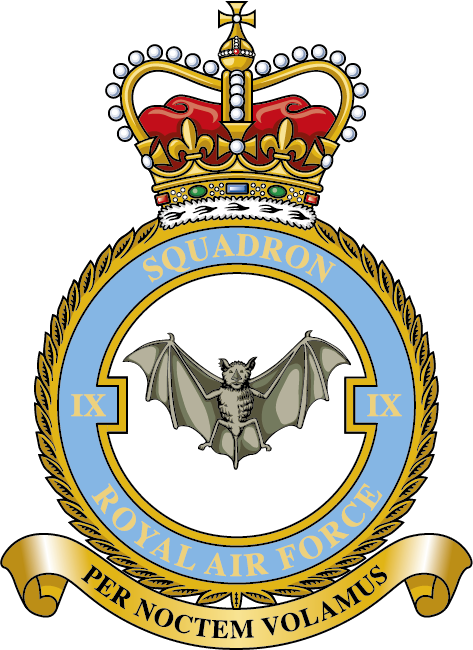
No. 9 Squadron is among the oldest bomber units in the Royal Air Force, tracing its line back to 1914. It entered the Second World War flying the Vickers Wellington from RAF Honington in Suffolk, and its crews were in action over the German fleet within hours of the declaration of war. In September 1942 the squadron re-equipped with the Avro Lancaster and moved to RAF Waddington, transferring the following spring to RAF Bardney in Lincolnshire as part of No. 5 Group.
From there No. 9 became one of Bomber Command’s specialist heavy-bombing units. Working often alongside No. 617 Squadron and armed with the 12,000lb Tallboy deep-penetration bomb, it took part in the campaign against the German battleship Tirpitz, helping to capsize her in a Norwegian fjord on 12 November 1944. The squadron carried the motto Per noctem volamus — “throughout the night we fly” — and went on to operate the Avro Lincoln and then English Electric Canberra jets after the war.
Royal Air Force Bomber Command, 1942-1945. Wing Commander J B "Willy" Tait, Commanding Officer of No. 617 Squadron RAF, gives his account of the successful raid carried out on the German battleship TIRPITZ in Tromso Fjord, Norway, (Operation CATECHISM) on 12 November 1944, during a press conference at the Ministry of Information, London. Sat next to Tait, in civilian clothes, is Air Commodore H A Jones, Director of Public Relations at the Air Ministry. Sitting on Jones' left is Squadron Leader A G Williams, who led No. 9 Squadron RAF on the raid. ⓘ licence & creditRoyal Air Force official photographer, Wilson J G (Plt Off) / Public domain, via Wikimedia Commons — https://commons.wikimedia.org/wiki/File:Royal_Air_Force_Bomber_Command,_1942-1945._CH14145.jpgView source & full licence →Royal Air Force Bomber Command, 1942-1945. The crew of Avro Lancaster B Mark III, ED831 'WS-H', of No 9 Squadron RAF, captained by Squadron Leader A M Hobbs RNZAF, boarding their aircraft at Bardney, Lincolnshire, for a raid on the Zeppelin works at Friedrichshafen, on the shores of Lake Constance (Bodensee), Germany. This special raid introduced novel tactics devised by No. 5 Group, among which was the 'shuttle' technique. After bombing the target, the Lancasters flew to Blida in North Africa, where they were refuelled and rearmed, returning to the United Kingdom two nights later and attacking La Spezia, Italy, en route. Six days later, Hobbs and his crew were shot down and killed in ED831, while returning from a raid on Gelsenkirchen, Germany, ⓘ licence & creditRoyal Air Force official photographer / Public domain, via Wikimedia Commons — https://commons.wikimedia.org/wiki/File:Royal_Air_Force_Bomber_Command,_1942-1945._CH10403.jpgView source & full licence →Royal Air Force Bomber Command, 1942-1945. The crew of Avro Lancaster B Mark III, ED689 'WS-K', of No. 9 Squadron RAF, headed by the captain, Flight Lieutenant J A Wakeford boarding their aircraft at Bardney, Lincolnshire, for their 50th mission, a raid on the Zeppelin works at Friedrichshafen, on the shores of Lake Constance (Bodensee), Germany. This special raid introduced novel tactics devised by No. 5 Group, among which was the 'shuttle' technique. After bombing the target, the Lancasters flew to Blida in North Africa, where they were refuelled and rearmed, returning to the United Kingdom two nights later and attacking Spezia, Italy, en route. Two weeks later, Wakeford and his crew were shot down and killed in ED689, during a raid to Cologne, Germany. ⓘ licence & creditRoyal Air Force official photographer / Public domain, via Wikimedia Commons — https://commons.wikimedia.org/wiki/File:Royal_Air_Force_Bomber_Command,_1942-1945._CH10404.jpgView source & full licence →Royal Air Force Bomber Command, 1939-1941. Wing Commander Richard Kellett, Commanding Officer of No. 149 Squadron RAF, seated at his desk at Mildenhall, Cambridgeshire. On 18 December 1939, Kellett led a force of 24 Vickers Wellingtons drawn from Nos. 9, 37 and 149 Squadrons to search for enemy shipping targets in the Schillig Roads off Wilhelmshaven, Germany. The Wellingtons were detected by a German radar station on Wangerooge Island while still on their approach flight, and were subsequently intercepted by fighters. Nine Wellingtons were shot down, three ditched into the sea and a further three were forced to seek other landing grounds as they were too badly damaged to return. Kellett was one of those shot down and became a prisoner-of-war. In January 1940 (when this picture was released) he was awarded the Distinguished Flying Cross for his leadership during this disastrous raid which, together with that of 14 December, had a major effect on future British bombing policy. ⓘ licence & creditRoyal Air Force official photographer / Public domain, via Wikimedia Commons — https://commons.wikimedia.org/wiki/File:Royal_Air_Force_Bomber_Command,_1939-1941._C439.jpgView source & full licence →Royal Air Force Bomber Command, 1942-1945. The German battleship TIRPITZ, lying capsized in in Tromso fjord, attended by a salvage vessel. The already damaged ship was finally sunk in a combined daylight attack by Nos. 9 and 617 Squadrons RAF on 12 November 1944, (Operation CATECHISM). The hole in the hull by the starboard propeller shaft was cut by the Germans to allow access to salvage crews. ⓘ licence & creditDaventry B J (Flt Lt), Royal Air Force official photographer / Public domain, via Wikimedia Commons — https://commons.wikimedia.org/wiki/File:Troms%C3%B6,_Royal_Air_Force_Bomber_Command,_1942-1945_CL2830.jpgView source & full licence →Royal Air Force Bomber Command, 1939-1945. Groundcrew of No. 9 Squadron RAF, clearing snow in front of a trailer bearing a 12,000 lb 'Tallboy' deep-penetration bomb, at Bardney, Lincolnshire, in the winter of 1944 - 1945. A wing of one of the Squadron's Avro Lancasters is seen in the foreground. ⓘ licence & creditRoyal Air Force official photographer / Public domain, via Wikimedia Commons — https://commons.wikimedia.org/wiki/File:Royal_Air_Force_Bomber_Command,_1939-1945._MH30802.jpgView source & full licence →Military personnel and dignitaries render a salute during the playing of national anthems at closing ceremony for the Air Forces from Finland and England at Mihail Kogalniceanu Air Base, Romania, July 23, 2024. U.S. European Command's joint forces are engaged, postured, and ready with credible force to assure, deter, and defend in an increasingly complex security environment. (U.S. Army photo by Sgt. 1st Class Flor Gonzalez) ⓘ licence & creditSgt. 1st Class Flor Gonzalez / Public domain, via Wikimedia Commons — https://commons.wikimedia.org/wiki/File:Closing_ceremony_for_the_Finnish_and_British_Air_Forces_at_Mihail_Kogalniceanu_Air_Base.jpgView source & full licence →British Royal Air Force Air Commodore Martin Cunningham delivers a speech during the NATO Certification Ceremony at Mihail Kogalniceanu Air Base, Romania, April 9, 2024. Allied Air Forces stand shoulder-to-shoulder to provide a robust collective defense and deliver constant vigilance across NATO airspace. (U.S. Army photo by Spc. Nolan Brewer) ⓘ licence & creditSpc. Nolan Brewer / Public domain, via Wikimedia Commons — https://commons.wikimedia.org/wiki/File:Air_Commodore_Martin_Cunningham_delivers_a_speech_at_MK_Air_Base,_Romania.jpgView source & full licence →British Royal Air Force Air Commodore Martin Cunningham delivers a speech during the NATO Certification Ceremony at Mihail Kogalniceanu Air Base, Romania, April 9, 2024. Allied Air Forces stand shoulder-to-shoulder to provide a robust collective defense and deliver constant vigilance across NATO airspace. (U.S. Army photo by Spc. Nolan Brewer) ⓘ licence & creditSpc. Nolan Brewer / Public domain, via Wikimedia Commons — https://commons.wikimedia.org/wiki/File:Air_Commodore_Martin_Cunningham_delivers_a_speech_at_MK_Air_Base,_Romania_(cropped).jpgView source & full licence →Image of a RAF Typhoon aircraft (centre), seen here flying with a MiG-21MF Lancer C aircraft (centre left) from the Romania Air Force. Royal Air Force Typhoon fighters supporting the NATO enhanced Air Policing mission in Romania carried out a welcome flypast over two NATO warships that have entered the Black Sea. RN and Dutch Royal Navy ships, HMS Defender and HNLMS Evertsen are part of the wider UK Carrier Strike Group 21 that is currently operating in the Mediterranean Sea. The two ships have recently entered the Black Sea to visit the ports of NATO Allied countries and to conduct exercises in the area. ⓘ licence & creditSAC Hazel Reader RAF / OGL 3, via Wikimedia Commons — https://commons.wikimedia.org/wiki/File:121EAW-OFFICIAL-20210614-0110-012.jpgView source & full licence →{{En-gb|1= badge.}} ⓘ licence & creditRoyal Air Force / Public domain, via Wikimedia Commons — https://commons.wikimedia.org/wiki/File:No._9_Squadron_RAF_badge.pngView source & full licence →