
RAF Wyton
England — County: Huntingdonshire
ⓘ licence & credit
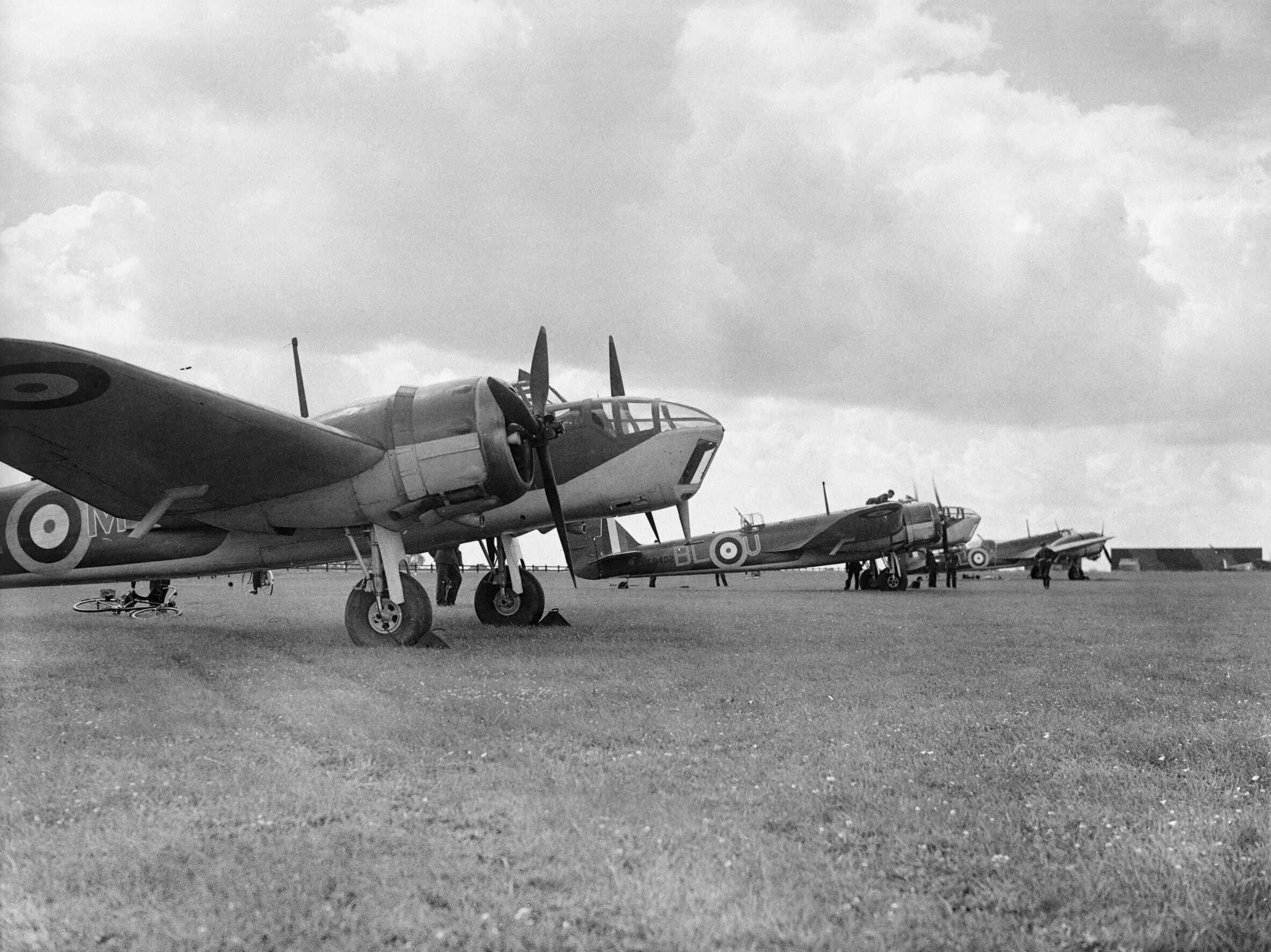
Royal Air Force official photographer, 1939-1941 (IWM CH 753) - Bristol Blenheim Mark IVs of No. 40 Squadron RAF lined up ready for a raid at Wyton, Cambridgeshire (via Wikimedia Commons, Public domain)About
RAF Wyton lies on the gravel terraces north of the Ouse in Huntingdonshire, four miles east of Huntingdon, on a patch of Cambridgeshire farmland that has been a flying field since the Royal Flying Corps moved in during 1916. Between the wars a long parade of training and bomber squadrons cycled through — Nos. 46, 65, 83, 104 and 156 among them — before the field was rebuilt in brick and concrete under the Expansion Scheme of the late 1930s. By the outbreak of war Wyton was a permanent station of the new RAF, home to Blenheim units of 2 Group, and on 3 September 1939 a Blenheim IV of No. 139 Squadron flown by Flying Officer Andrew McPherson became the first RAF aircraft to cross the German frontier in the Second World War — a reconnaissance over Wilhelmshaven that earned McPherson the DFC.
In August 1942 the station took on the role it is best remembered for. Air Commodore Don Bennett — at thirty-two the youngest officer ever to reach air rank in the RAF — set up the headquarters of the Pathfinder Force at Wyton, drawing in one squadron from each of Bomber Command’s heavy groups: No. 7 with Stirlings, No. 35 with Halifaxes, No. 83 with Lancasters, No. 109 with Wellingtons (and soon Mosquitoes) and No. 156 with Wellingtons. The PFF was elevated to No. 8 (Pathfinder) Group in January 1943, growing eventually to nineteen squadrons whose target-marking made area-bombing accuracy possible. Wyton itself flew Lancasters with 83 and 156 Squadrons and Mosquitoes with 109 and, later, 128 and 163 Squadrons of the Light Night Striking Force; Nos. 15, 40 and 57 had earlier rotated through with Wellingtons and Halifaxes. By 1945 the airmen of 8 Group had paid heavily — Pathfinder casualty rates were among the worst in Bomber Command — but their flares had guided the heavies onto everything from the Ruhr dams to Berlin.
The bombers left after the war but Wyton’s runways stayed busy. From the early 1950s the station became the centre of RAF strategic reconnaissance, flying English Electric Canberras of Nos. 58, 82 and 540 Squadrons over Europe and the Mediterranean, then Vickers Valiants from 1955 and Handley Page Victor B(SR).2s of No. 543 Squadron from 1959, the latter carrying out high-altitude photographic and radar surveys deep into the Cold War. The V-bombers had gone by the mid-1970s but the intelligence thread held.
Wyton remains an active RAF station. Since 2013 it has hosted the Defence Intelligence Joint Service Signals Organisation, the National Centre for Geospatial Intelligence and other elements of UK military intelligence under what is now Pathfinder Building — a deliberate nod to the airfield’s wartime identity. No. 1 ISR Wing and the Joint Forces Intelligence Group are based on the site; the runway itself is used only for light aircraft, but the work done at Wyton remains in the same line of business it pioneered in 1942: finding things, very precisely, a long way away.
Photographs
ⓘ licence & credit
Stanley Devon / Public domain, via Wikimedia Commons — https://commons.wikimedia.org/wiki/File:Bristol_Blenheim_-_Wyton_-_Royal_Air_Force_Bomber_Command,_1939-1941._CH761.jpgView source & full licence →ⓘ licence & credit
Stanley Devon / Public domain, via Wikimedia Commons — https://commons.wikimedia.org/wiki/File:Bristol_Blenheim_-_Wyton_-_Royal_Air_Force_Bomber_Command,_1939-1941._CH753.jpgView source & full licence →ⓘ licence & credit
Stanley Devon / Public domain, via Wikimedia Commons — https://commons.wikimedia.org/wiki/File:Bristol_Blenheim_-_Wyton_-_Royal_Air_Force_Bomber_Command,_1939-1941._CH726.jpgView source & full licence →ⓘ licence & credit
Stanley Devon / Public domain, via Wikimedia Commons — https://commons.wikimedia.org/wiki/File:Bristol_Blenheim_-_Wyton_-_Royal_Air_Force_Bomber_Command,_1939-1941._CH717.jpgView source & full licence →ⓘ licence & credit
Stanley Devon / Public domain, via Wikimedia Commons — https://commons.wikimedia.org/wiki/File:40_Squadron_Blenheims_at_RAF_Wyton_WWII_IWM_CH_732.jpgView source & full licence →Home to
- No. 40 Squadron — 3 Group
- No. 83 Squadron — 8 Group
- No. 109 Squadron — 8 Group
- No. 128 Squadron — 8 Group
- No. 163 Squadron — 8 Group
People connected to this base
43 persons cross-referenced to this airfield — through a posting here, a squadron based here, or aircrew who flew from it.
| Name | Rank | Connection | Dates |
|---|---|---|---|
| Ackland, Leslie James | Flight Lieutenant | Aircrew (squadron based here) | — |
| Armstrong, John David | Squadron Leader | Aircrew (squadron based here) | — |
| Arrieta, C M | — | Aircrew (squadron based here) | — |
| Breed, M R | — | Aircrew (squadron based here) | — |
| Bright, John Alexander | Flight Lieutenant | Aircrew (squadron based here) | — |
| Carpenter, Eric Charles | Flight Lieutenant | Aircrew (squadron based here) | — |
| Casey, Allan James | Flight Sergeant | Aircrew (squadron based here) | — |
| Collins, George Barrowby | Flying Officer | Aircrew (squadron based here) | — |
| Ellis, Jack Llewellyn | Flight Lieutenant | Aircrew (squadron based here) | — |
| Flett, Adam Herd | Warrant Officer | Aircrew (squadron based here) | — |
| Fredman, Norman Henry | Flight Lieutenant | Aircrew (squadron based here) | — |
| Gillespie, Anthony Edward | Flight Sergeant | Aircrew (squadron based here) | — |
| Hawthorne, Austin Arthur | Flying Officer | Aircrew (squadron based here) | — |
| Heitmann, Alan Walter | Flight Lieutenant | Aircrew (squadron based here) | — |
| Henry, Cyril Reginald | Flight Lieutenant | Aircrew (squadron based here) | — |
| Holmes, Joseph Sydney | Flying Officer | Aircrew (squadron based here) | — |
| Hynes, Keith Frederick | Flying Officer | Aircrew (squadron based here) | — |
| Jackson, Frederick Roy | Flying Officer | Aircrew (squadron based here) | — |
| Kay, Desmond Hayward Sidley | Squadron Leader | Aircrew (squadron based here) | — |
| King, Kenneth Henry | Pilot Officer | Aircrew (squadron based here) | — |
| Knill, Leslie | Flight Sergeant | Aircrew (squadron based here) | — |
| Lagesse, Marie Joseph Marc | — | Aircrew (squadron based here) | — |
| Leigh, Robert Eric | Flying Officer | Aircrew (squadron based here) | — |
| Logan, Ray Hutchings | Pilot Officer | Aircrew (squadron based here) | — |
| Maconachie, James Roy Alexander | Flying Officer | Aircrew (squadron based here) | — |
| McAllister, John | Flight Sergeant | Aircrew (squadron based here) | — |
| McGreal, John Trevor | Flight Lieutenant | Aircrew (squadron based here) | — |
| McKenna, Charles Daniel | Flying Officer | Aircrew (squadron based here) | — |
| McNulty, Neville Milne | Flying Officer | Aircrew (squadron based here) | — |
| Merrett, Raymond Leslie | Flight Sergeant | Aircrew (squadron based here) | — |
| Mitchell, Peter Edward | Flying Officer | Aircrew (squadron based here) | — |
| Murphy, Joseph Harold Michael | Pilot Officer | Aircrew (squadron based here) | — |
| Olde, William James | Pilot Officer | Aircrew (squadron based here) | — |
| Palmer, Robert Anthony Maurice | Squadron Leader | Squadron served here | — |
| Ridley, John Kenneth | Pilot Officer | Aircrew (squadron based here) | — |
| Schildknecht, Albert Edmond | Flight Sergeant | Aircrew (squadron based here) | — |
| Stegman, Lance Anthony | Flight Sergeant | Aircrew (squadron based here) | — |
| Stephens, Harry Bernard | Squadron Leader | Aircrew (squadron based here) | — |
| Strouts, Frederick Stanley | Pilot Officer | Aircrew (squadron based here) | — |
| Tuck, George William | Flying Officer | Aircrew (squadron based here) | — |
| Walker, John | Flying Officer | Aircrew (squadron based here) | — |
| Whyte, William Edward | Flying Officer | Aircrew (squadron based here) | — |
| Wood, James Knox | Flight Lieutenant | Aircrew (squadron based here) | — |