
de Havilland Mosquito
Light bomber · de Havilland · United Kingdom
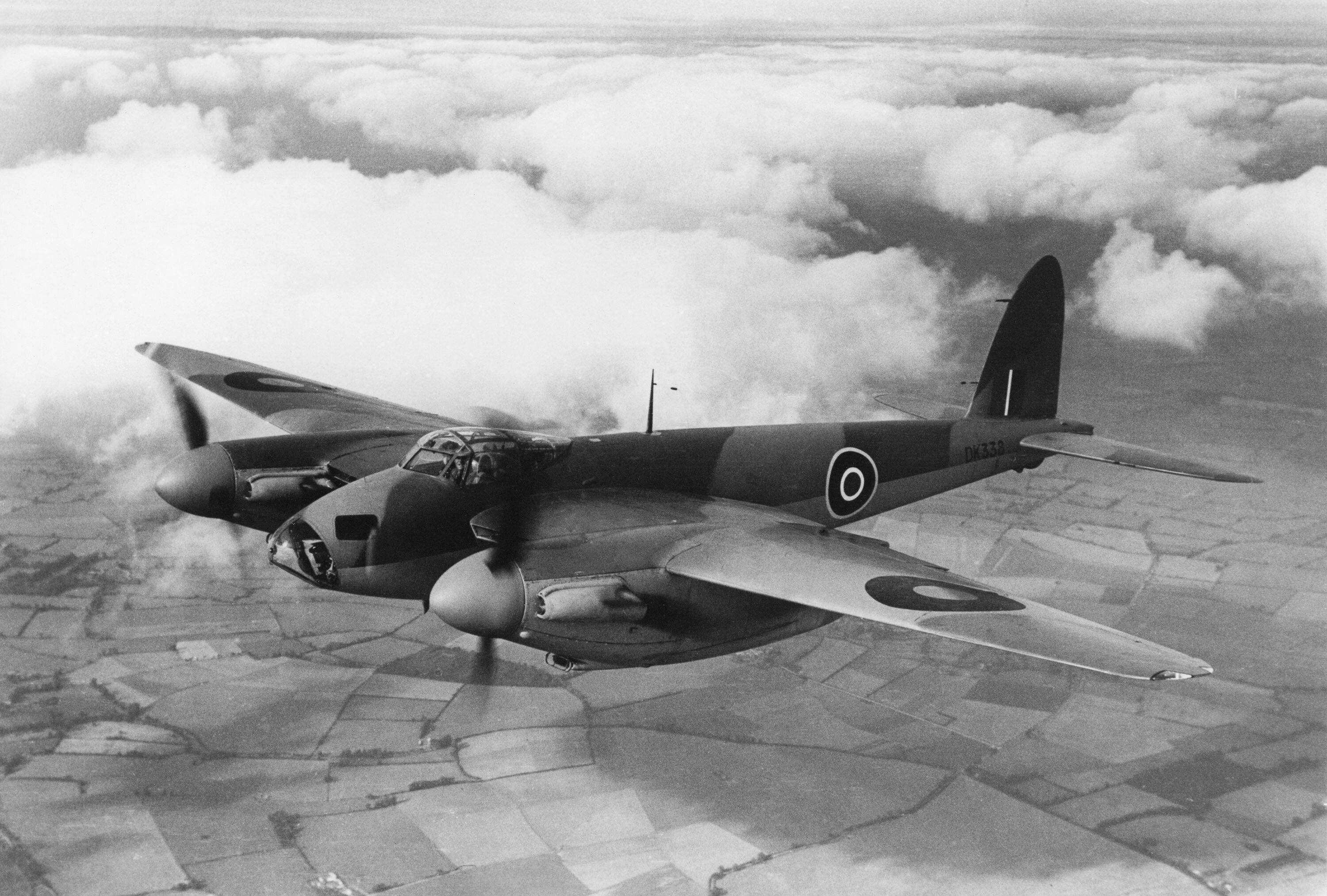
ⓘ licence & credit
Fotoafdrukken Koninklijke Luchtmacht / Photo Prints, Royal Netherlands Air Force; restored by Chris Woodrich / CC BY-SA 4.0, via Wikimedia Commons — https://commons.wikimedia.org/wiki/File:De_Havilland_DH.98_Mosquito_B_Mk_IV_Series_2_(restoration).jpg| Typical crew | 2 |
|---|---|
| Engines | 2 × Rolls-Royce Merlin |
| First flight | 1940 |
| Number built | 7,781 |
About
The de Havilland Mosquito was one of the war’s most versatile aircraft, and one of its most unusual: built almost entirely of wood, it earned the nickname the “Wooden Wonder”. De Havilland’s gamble was that a light, streamlined wooden airframe — laminated from balsa and birch and assembled by furniture and cabinet makers — could outrun fighters rather than fight them. The prototype flew in November 1940.
Powered by two Rolls-Royce Merlins, the Mosquito exceeded 400 mph, and conceived as an unarmed fast bomber it expanded into dozens of variants: night fighter, pathfinder, fighter-bomber, intruder, anti-shipping strike and high-altitude photo-reconnaissance. In Bomber Command it led the Pathfinder force and the precision raids of the Light Night Striking Force, suffering some of the lowest loss rates of any type. Around 7,780 were built, several preserved examples surviving in museums in Britain and abroad.
Sources: This page was compiled from publicly available historical sources, including De Havilland Mosquito — Wikipedia and The Wooden Wonder of the RAF — RAF Museum. The text is original and has been written from factual source material; no source text has been copied unless specifically quoted and attributed.
Engines
- Rolls-Royce Merlin — 60° liquid-cooled supercharged V12, 27 litres
3D model
3D model: de Havilland D.H.98 Mosquito (“Dh98”) by manilov.ap on Sketchfab, licensed CC BY 4.0.
Airframes in this database
| Serial | Code | Squadron | Fate |
|---|---|---|---|
| HX922 | EG-F | — | Lost on operations |
| LR503 | GB-F | 105 | Written off (non-op) |