

- Died
- 4 March 1945, aged 23
- Fate
- Killed in action
Biography
Hugh William Eliot was born in Lewisham, London, on 16 April 1921, and worked for Lloyds Bank after schooling at St Dunstan’s College and Dulwich College before taking a short service commission in the RAF in mid-1939. Flying Hawker Hurricanes, he saw action in the Battle of France with No. 73 Squadron in May 1940 and went on to fly in the air fighting over southern England, before being posted to the besieged island of Malta in late 1940, where he served with Nos. 261 and 185 Squadrons; the DFC announced in the London Gazette on 23 September 1941 (the citation gazetted on 26 September 1941) recognised this period of fighter and night-fighting work. Moving to night fighters, he flew Bristol Beaufighters with No. 255 Squadron and in September 1944 took command of No. 256 Squadron in Italy, operating the de Havilland Mosquito. By the war’s end he was credited with around nine enemy aircraft destroyed across several theatres. On the night of 4 March 1945, while attacking a bridge in northern Italy in Mosquito HK178, his aircraft was hit by anti-aircraft fire and he was killed alongside his navigator, Flight Lieutenant W. T. Cox; he was 23. Eliot was buried in Argenta Gap War Cemetery in Italy, and the Distinguished Service Order he had earned was gazetted after his death.
Burial / commemoration
- Cemetery
- Argenta Gap War Cemetery, Italy
Operations on this date. 3 raids in this archive were flown on the night of 4 March 1945: Kamen · Wanne-eickel · Berlin. (Cross-reference by date — not in itself confirmation this airman flew it.)
Timeline
-
23 September 1941
Gazetted: DSO
Distinguished Service Order -
4 March 1945
Lost in de Havilland Mosquito HK178
Other -
4 March 1945
Died
aged 23
Crew & operations
Flew as Other with No. 256 Squadron.
- Lost on HK178 (de Havilland Mosquito) — Failed to return
Awards
-
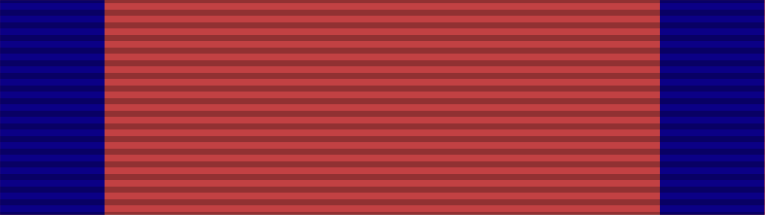 Distinguished Service Order (DSO) — gazetted 23 September 1941