
Consolidated Catalina
Maritime patrol · Consolidated Aircraft · United States
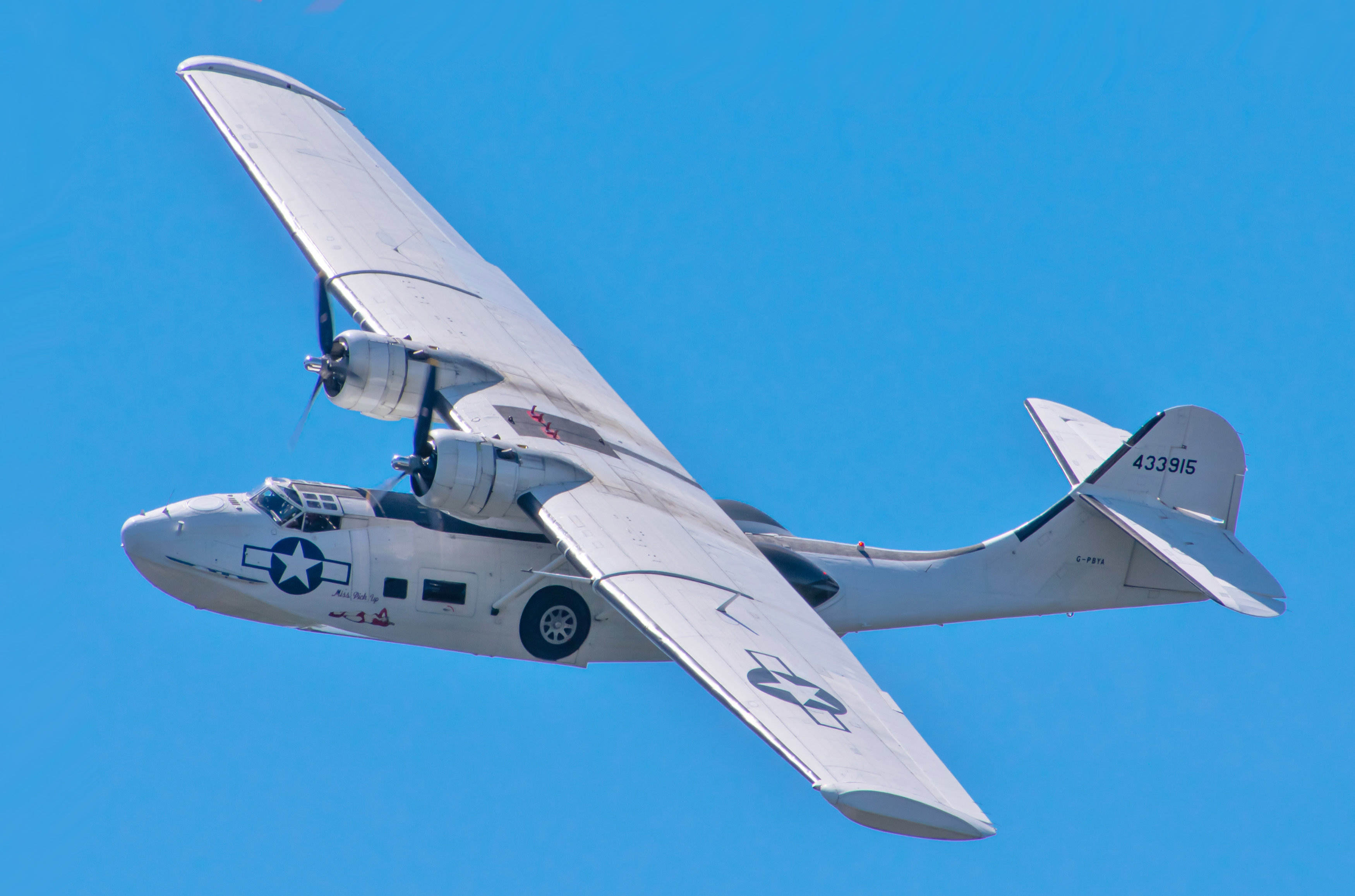
ⓘ licence & credit
Filipe Sousa (via Wikimedia Commons, Public domain)| Typical crew | 8 |
|---|---|
| Engines | 2 × Pratt & Whitney Twin Wasp |
| First flight | 1935 |
| Number built | 3,305 |
Photographs
ⓘ licence & credit
Unknown authorUnknown author or not provided / Public domain, via Wikimedia Commons — https://commons.wikimedia.org/wiki/File:African-American_mechanics_work_on_PBY_at_NAS_Seattle,_WA,_Alvin_V._Morrison,_AMM_3-c,_doing_overhaul,_04-27-1944_-_NARA_-_520648_restored.jpgView source & full licence →ⓘ licence & credit
Howard R. Hollem / Public domain, via Wikimedia Commons — https://commons.wikimedia.org/wiki/File:A_sailor_mechanic_refueling_a_plane_at_the_Naval_Air_Base,_Corpus_Christi,1a34918v.jpgView source & full licence →ⓘ licence & credit
National Museum of the U.S. Navy / Public domain, via Wikimedia Commons — https://commons.wikimedia.org/wiki/File:80-G-475740_(TR-5292)_(22698126207).jpgView source & full licence →ⓘ licence & credit
National Museum of the U.S. Navy / Public domain, via Wikimedia Commons — https://commons.wikimedia.org/wiki/File:80-G-475738_(TR-5244)_(23116501015).jpgView source & full licence →ⓘ licence & credit
National Museum of the U.S. Navy / Public domain, via Wikimedia Commons — https://commons.wikimedia.org/wiki/File:80-G-475734_(TR-5228)_(22698133007).jpgView source & full licence →ⓘ licence & credit
National Museum of the U.S. Navy / Public domain, via Wikimedia Commons — https://commons.wikimedia.org/wiki/File:80-G-475733_(TR-5224)_(23116508745).jpgView source & full licence →ⓘ licence & credit
U.S. Navy / Public domain, via Wikimedia Commons — https://commons.wikimedia.org/wiki/File:80-G-19974_(16892127579).jpgView source & full licence →ⓘ licence & credit
San Diego Air & Space Museum Archives / Public domain, via Wikimedia Commons — https://commons.wikimedia.org/wiki/File:23_0074640_Convair_Negative_Image_-_Consolidated_PBY_Catalina_concept_art_(54283587575).jpgView source & full licence →ⓘ licence & credit
San Diego Air & Space Museum Archives / Public domain, via Wikimedia Commons — https://commons.wikimedia.org/wiki/File:23_0042843_Convair_Negative_Image_-_Consolidated_PBY_Catalina_Illustration_(53753108835).jpgView source & full licence →ⓘ licence & credit
Unknown authorUnknown author or not provided / Public domain, via Wikimedia Commons — https://commons.wikimedia.org/wiki/File:%22African-American_mechanics_work_on_PBY_at_NAS_Seattle,_WA,_Alvin_V._Morrison,_AMM_3-c,_doing_overhaul.%22,_04-27-1944_-_NARA_-_520648.jpgView source & full licence →About
The Consolidated Catalina was the long-legged American flying boat that helped the RAF win the Battle of the Atlantic. Around 700 served with Coastal Command from early 1941, first equipping Nos. 209 and 240 Squadrons; slow but immensely enduring, a Catalina could stay airborne for the better part of a day, shadowing convoys far out into the ocean.
Its most celebrated moment came on 26 May 1941, when a No. 209 Squadron Catalina relocated the battleship Bismarck after the Royal Navy had lost contact, allowing the warships to close in. Working alongside the Short Sunderland and the very-long-range Consolidated Liberator, Catalinas were credited with destroying around forty U-boats during the war — and on 7 May 1945 a No. 210 Squadron Catalina sank the last U-boat claimed by Coastal Command. The type also flew tirelessly on air-sea rescue, plucking downed aircrew from the water.
Sources: This page was compiled from publicly available historical sources, including Consolidated Catalina in British Service — historyofwar.org and Consolidated PBY Catalina — Wikipedia. The text is original and has been written from factual source material; no source text has been copied unless specifically quoted and attributed.
Airframes in this database
| Serial | Code | Squadron | Fate |
|---|---|---|---|
| 9754 | P | — | Lost on operations |
| JV928 | DA-Y | — | Survived the war |