
Short Stirling
Heavy bomber · Short Brothers · United Kingdom
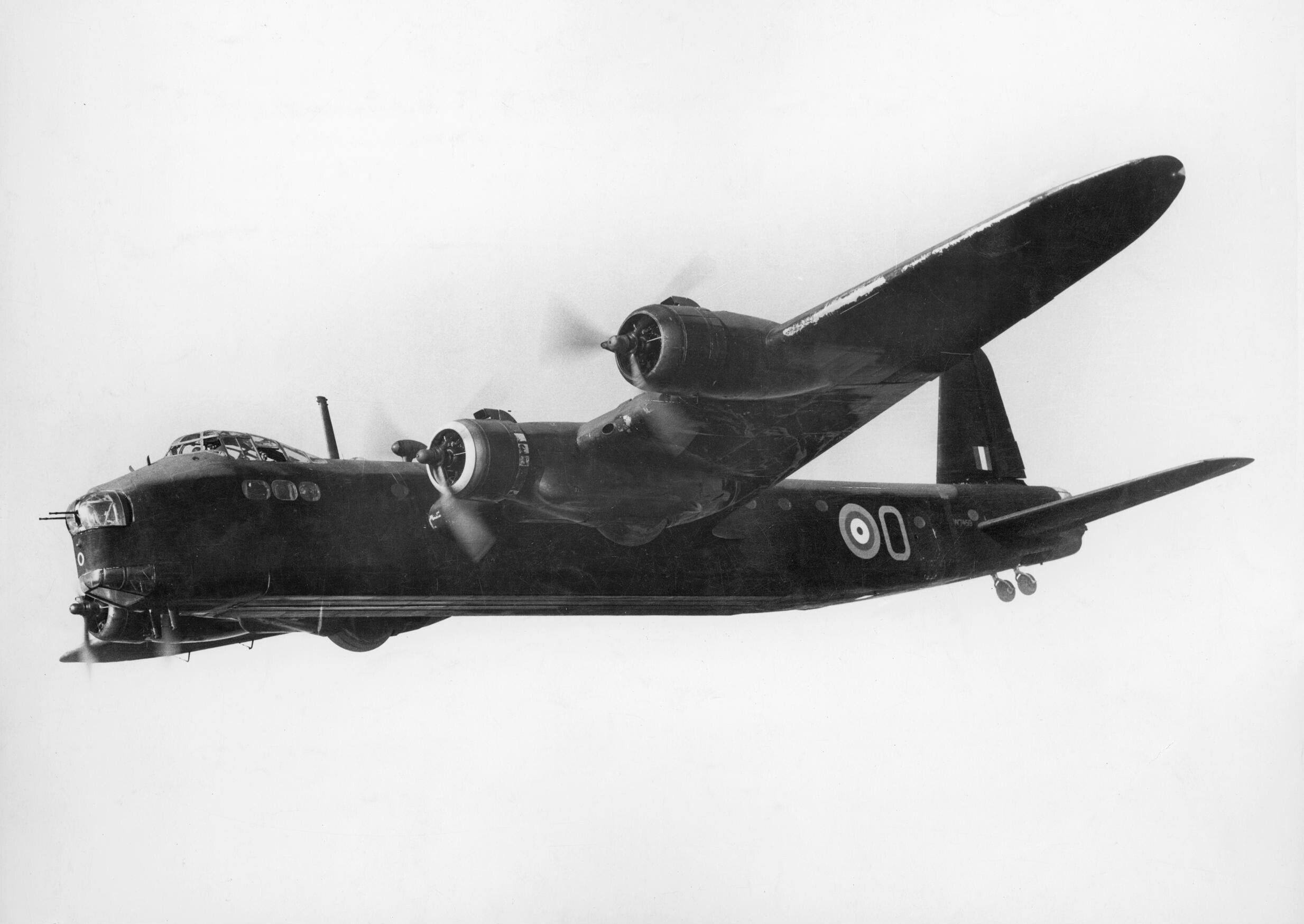
ⓘ licence & credit
Press Agency photographer (via Wikimedia Commons, Public domain)| Typical crew | 7 |
|---|---|
| Engines | 4 × Bristol Hercules |
| First flight | 1939 |
| Number built | 2,371 |
Photographs
ⓘ licence & credit
Forward (Flying Officer), Royal Air Force official photographer / Public domain, via Wikimedia Commons — https://commons.wikimedia.org/wiki/File:Aircraft_of_the_Royal_Air_Force_1939-1945-_Short_S.29_Stirling._CH6308.jpgView source & full licence →ⓘ licence & credit
Royal Air Force official photographer, Woodbine G (Mr) / Public domain, via Wikimedia Commons — https://commons.wikimedia.org/wiki/File:Aircraft_of_the_Royal_Air_Force_1939-1945-_Short_S.29_Stirling._CH5476.jpgView source & full licence →ⓘ licence & credit
Royal Air Force official photographer / Public domain, via Wikimedia Commons — https://commons.wikimedia.org/wiki/File:Aircraft_of_the_Royal_Air_Force_1939-1945-_Short_S.29_Stirling._CH3138.jpgView source & full licence →ⓘ licence & credit
Clark N S (F/O), Royal Air Force official photographer / Public domain, via Wikimedia Commons — https://commons.wikimedia.org/wiki/File:Aircraft_of_the_Royal_Air_Force_1939-1945-_Short_S.29_Stirling._CH12683.jpgView source & full licence →ⓘ licence & credit
Office for Emergency Management. Office of War Information. Domestic Operations Branch. Bureau of Special Services. 3/9/1943-9/15/1945 / Public domain, via Wikimedia Commons — https://commons.wikimedia.org/wiki/File:A_Flight_of_%22Stirling%22_Bombers_out_on_a_Raid_-_DPLA_-_1181faba08de6297beba09d9b3View source & full licence →ⓘ licence & credit
Beaton, Cecil (Photographer) / Public domain, via Wikimedia Commons — https://commons.wikimedia.org/wiki/File:A_Cecil_Beaton_photograph_of_the_navigator_working_at_his_chart_table_in_an_RAF_Stirling_bomber,_1941._D4738_2.jpgView source & full licence →ⓘ licence & credit
British Government service personnel / Public domain, via Wikimedia Commons — https://commons.wikimedia.org/wiki/File:75_Squadron_RNZAF_Short_Stirling_AA-C_en_route_for_26th_mission.jpgView source & full licence →ⓘ licence & credit
Bellamy W (P/O), Royal Air Force official photographer / Public domain, via Wikimedia Commons — https://commons.wikimedia.org/wiki/File:7_Squadron_RAF_Stirlings_in_flight_IWM_CH_4782.jpgView source & full licence →ⓘ licence & credit
Royal Air Force official photographer / Public domain, via Wikimedia Commons — https://commons.wikimedia.org/wiki/File:7_Squadron_RAF_Stirling_taking_off_from_Oakington_IWM_CH_3145.jpgView source & full licence →ⓘ licence & credit
Ministry of Information Photo Division Photographer / Public domain, via Wikimedia Commons — https://commons.wikimedia.org/wiki/File:218_Squadron_Stirling_IWM_D_8973.jpgView source & full licence →ⓘ licence & credit
British Government / Public domain, via Wikimedia Commons — https://commons.wikimedia.org/wiki/File:214_Squadron_Stirling_RAF_Stradishall_IWM_ATP_11154D.jpgView source & full licence →ⓘ licence & credit
Devon S D (Flight Lieutenant) Royal Air Force official photographer. / Public domain, via Wikimedia Commons — https://commons.wikimedia.org/wiki/File:1st_Airborne_Oslo.jpgView source & full licence →ⓘ licence & credit
San Diego Air & Space Museum Archives / Public domain, via Wikimedia Commons — https://commons.wikimedia.org/wiki/File:15_Short_Stirling_(15650912467).jpgView source & full licence →ⓘ licence & credit
San Diego Air & Space Museum Archives / Public domain, via Wikimedia Commons — https://commons.wikimedia.org/wiki/File:15_Short_Stirling_(15216625203).jpgView source & full licence →ⓘ licence & credit
San Diego Air & Space Museum Archives / Public domain, via Wikimedia Commons — https://commons.wikimedia.org/wiki/File:15_Short_Stirling_(15216076644).jpgView source & full licence →ⓘ licence & credit
Stanley Devon / Public domain, via Wikimedia Commons — https://commons.wikimedia.org/wiki/File:Royal_Air_Force-_Fighter_Command,_No._38_(airborne_Forces)_Group_RAF._CL2428.jpgView source & full licence →ⓘ licence & credit
Ministry of Information Photo Division Photographer / Public domain, via Wikimedia Commons — https://commons.wikimedia.org/wiki/File:Royal_Air_Force_Bomber_Command,_1942-1945._D8976.jpgView source & full licence →ⓘ licence & credit
Brock F J (Fg Off), Royal Air Force official photographer / Public domain, via Wikimedia Commons — https://commons.wikimedia.org/wiki/File:Royal_Air_Force_Bomber_Command,_1942-1945._CH5287.jpgView source & full licence →ⓘ licence & credit
Brock F J (Mr), Royal Air Force official photographer / Public domain, via Wikimedia Commons — https://commons.wikimedia.org/wiki/File:Royal_Air_Force_Bomber_Command,_1942-1945._CH5282.jpgView source & full licence →About
The Short Stirling holds a particular distinction: it was the first four-engined heavy bomber designed from the outset to enter RAF service. Answering a 1936 Air Ministry requirement, it first flew in May 1939 and reached No. 7 Squadron in 1940, flying its first operation in February 1941 against oil installations near Rotterdam.
Its great handicap was written into the specification. To fit existing hangars the wingspan was capped at about 100 feet, leaving the wing too short to lift the aircraft to the altitudes its rivals reached. Powered by four Bristol Hercules radials, the Stirling cruised lower than the Lancaster or Halifax and grew vulnerable as German defences improved. Withdrawn from the main bombing force from 1943, it found a productive second life as a glider tug, transport and special-duties aircraft. Around 2,380 were built, flying some 14,500 bombing operations.
Sources: This page was compiled from publicly available historical sources, including Short Stirling — Military Factory and Short Stirling — Wikipedia. The text is original and has been written from factual source material; no source text has been copied unless specifically quoted and attributed.
Engines
- Bristol Hercules — 14-cylinder two-row air-cooled sleeve-valve radial, 38.7 litres
Airframes in this database
| Serial | Code | Squadron | Fate |
|---|---|---|---|
| BF372 | OJ-H | 149 | Lost on operations |
| BF378 | LS-T | 15 | Lost on operations |
| BF411 | LS-A | 15 | Lost on operations |
| BF457 | LS-B | 15 | Lost on operations |
| BK627 | WP-P | 90 | Lost on operations |
| EF452 | HA-O | 218 | Lost on operations |
| EH930 | EX-N | 199 | Unknown |
| N6086 | LS-F | 15 | Written off (non-op) |
| R9276 | WP-G | 90 | Lost on operations |