
RAF Scampton
England — County: Lincolnshire
ⓘ licence & credit
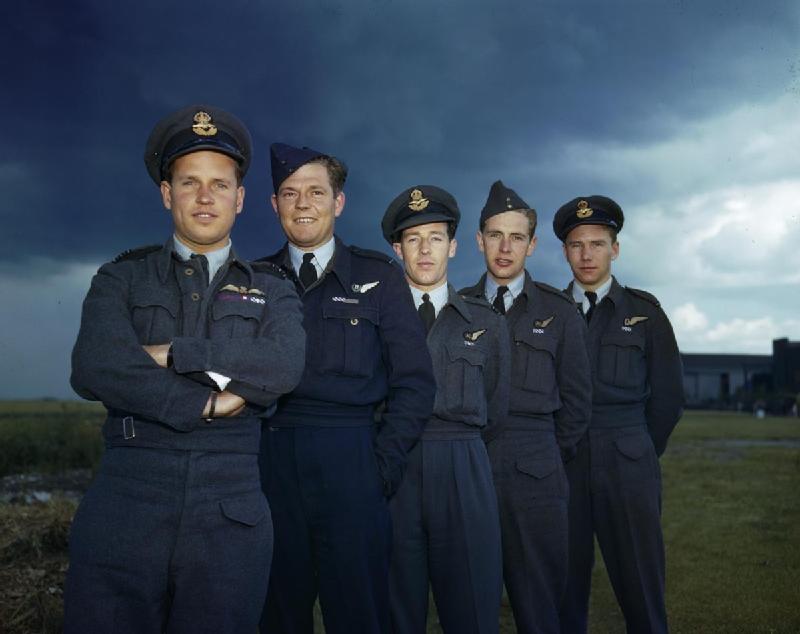
RAF official photographer, 22 July 1943 (IWM TR 1127, via Wikimedia Commons; Public Domain — UK Crown copyright expired)About
RAF Scampton sits on the Lincolnshire Edge, six miles north of Lincoln, on land that has carried military aviation almost without interruption since 1916. A Royal Flying Corps Home Defence flight first operated F.E.2b biplanes from a field at nearby Brattleby that year, hunting Zeppelins over the East Coast. The station was renamed Scampton in 1917 and grew into a training depot before being wound down at the end of the First World War. The RAF returned to the same ground in 1936 under the inter-war Expansion Scheme, rebuilding the station with C-type hangars in preparation for the war that everyone could see coming.
When that war began in September 1939, Scampton was home to two squadrons of Handley Page Hampdens — Nos. 49 and 83 — flying with No. 5 Group, Bomber Command. Their Hampdens were among the first RAF bombers to attack German targets, and through 1940 and 1941 the same squadrons absorbed heavy losses on long minelaying sorties over German coastal waters, code-named “Gardening”. Two airmen won the Victoria Cross flying out of Scampton in those early years: Roderick Learoyd of No. 83 Squadron, for a low-level attack on the Dortmund–Ems Canal in August 1940, and the same squadron’s wireless operator John Hannah, for fighting a bomb-bay fire on the way home from Antwerp a month later. The Hampdens were succeeded by the short-lived Avro Manchester and then by the four-engined Avro Lancaster that would carry Scampton through the rest of the war.
The station is best known for what happened on the night of 16/17 May 1943. Nineteen Lancasters of the newly-formed No. 617 Squadron took off from Scampton under Wing Commander Guy Gibson, each carrying one of Barnes Wallis’s bouncing mines bound for the Ruhr dams. The squadron breached the Möhne and Eder; eight aircraft did not return, and fifty-three of the crews were killed. Gibson received the Victoria Cross. After Operation Chastise the station was closed for runway work and reopened in late 1944 with three concrete runways. Lancasters of Nos. 153 and 625 Squadrons flew its later bombing missions, the last on 25 April 1945 against the Obersalzberg complex above Berchtesgaden. By the end of the war Scampton had lost 551 aircrew and 266 aircraft.
The base stayed operational for almost eighty more years. American B-29s flew from here in the late 1940s, English Electric Canberras through the early 1950s, and Avro Vulcans from 1958 — the three Vulcan squadrons forming the “Scampton Wing”, armed with Blue Steel stand-off nuclear missiles until the Royal Navy’s Polaris submarines assumed Britain’s deterrent role in 1968. The Vulcans gave way in 1983 to the Central Flying School and its training aircraft, and from 2001 the Red Arrows aerobatic team displayed and trained from Scampton. The Red Arrows moved to RAF Waddington in October 2022, and the Ministry of Defence formally closed the station in March 2023.
Sources: This page was compiled from publicly available historical sources, including Airfields Google Sheet (curated) and Wikipedia: RAF Scampton. The text is original and has been written from factual source material; no source text has been copied unless specifically quoted and attributed.
Photographs
ⓘ licence & credit
Royal Air Force official photographer, Daventry B J (Fg Off) / Public domain, via Wikimedia Commons — https://commons.wikimedia.org/wiki/File:Royal_Air_Force_Bomber_Command,_1941-1945._CH6428.jpgView source & full licence →ⓘ licence & credit
Daventry B J (F/O), Royal Air Force official photographer / Public domain, via Wikimedia Commons — https://commons.wikimedia.org/wiki/File:Royal_Air_Force_Bomber_Command,_1942-1945._CH6425.jpgView source & full licence →ⓘ licence & credit
Clark N S (Plt Off), Royal Air Force official photographer / Public domain, via Wikimedia Commons — https://commons.wikimedia.org/wiki/File:Royal_Air_Force_Bomber_Command,_1942-1945._CH8792.jpgView source & full licence →No people are cross-referenced to this airfield yet. Links appear as squadron postings, crews and service records are added.