
Handley Page Hampden
Medium bomber · Handley Page · United Kingdom
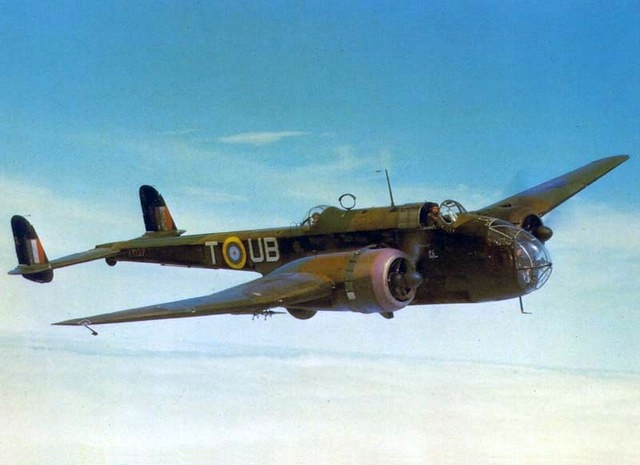
ⓘ licence & credit
Royal Air Force official photographer; The original uploader was Bzuk at English Wikipedia., 28 May 2007 (original upload date) (via Wikimedia Commons, Public domain)| Typical crew | 4 |
|---|---|
| Engines | 2 × Bristol Pegasus |
| First flight | 1936 |
| Number built | 1,430 |
Photographs
ⓘ licence & credit
Alan Wilson / CC BY-SA 2.0, via Wikimedia Commons — https://commons.wikimedia.org/wiki/File:Engine_and_parts_from_Handley_Page_HP.52_Hampden_Mk.I_(P1273_-_PL-Q)_(with_FN4A_turret)_(50490492776).jpgView source & full licence →ⓘ licence & credit
Flickr user "summer photo hobby" : https://www.flickr.com/photos/79818573@N04 / CC BY 2.0, via Wikimedia Commons — https://commons.wikimedia.org/wiki/File:Bristol_Pegasus_engine_from_crashed_Hampden_Flickr_7326134956.jpgView source & full licence →ⓘ licence & credit
Daventry B J (Mr), Royal Air Force official photographer / Public domain, via Wikimedia Commons — https://commons.wikimedia.org/wiki/File:Aircraft_of_the_Royal_Air_Force_1939-1945-_Handley_Page_Hp.52_Hampden_and_Hereford._CH3478.jpgView source & full licence →ⓘ licence & credit
Royal Air Force official photographer / Public domain, via Wikimedia Commons — https://commons.wikimedia.org/wiki/File:Aircraft_of_the_Royal_Air_Force_1939-1945-_Handley_Page_Hp.52_Hampden_and_Hereford._CH155.jpgView source & full licence →ⓘ licence & credit
San Diego Air & Space Museum Archives / Public domain, via Wikimedia Commons — https://commons.wikimedia.org/wiki/File:15_Handley_Page_Hampden_(15650368358).jpgView source & full licence →ⓘ licence & credit
San Diego Air & Space Museum Archives / Public domain, via Wikimedia Commons — https://commons.wikimedia.org/wiki/File:15_Handley_Page_H.P.52_Hampden_Mk.I_L4159._(15650369808).jpgView source & full licence →ⓘ licence & credit
Emoscopes / CC BY-SA 2.5, via Wikimedia Commons — https://commons.wikimedia.org/wiki/File:Handley_Page_Hampden.pngView source & full licence →ⓘ licence & credit
Emoscopes 20:59, 7 April 2008 (UTC) / CC BY 3.0, via Wikimedia Commons — https://commons.wikimedia.org/wiki/File:British_WW2_medium_bombers_comparison.pngView source & full licence →ⓘ licence & credit
whatsthatpicture from Hanwell, London, UK / CC BY 2.0, via Wikimedia Commons — https://commons.wikimedia.org/wiki/File:Loading_bombs_onto_a_World_War_II_Handley_Page_Hampden_(4821425043).jpgView source & full licence →About
The Handley Page Hampden was one of the trio of twin-engined bombers — with the Vickers Wellington and Armstrong Whitworth Whitley — with which the RAF went to war in 1939. Designed to the same 1932 day-bomber specification as the Wellington, the prototype flew in June 1936, and No. 49 Squadron at RAF Scampton was among the first to receive it in 1938.
Crews knew it as the “Flying Suitcase” for its narrow, slab-sided fuselage, which packed four men into cramped, separate stations. Powered by two Bristol Pegasus radials, it was nimble for its size but lightly armed and poorly suited to daylight operations against fighters. The Hampden flew in the first night raid on Berlin and the first 1,000-bomber raid on Cologne before being retired from Bomber Command in late 1942; it then served as a torpedo bomber with Coastal Command. Around 1,430 were built.
Sources: This page was compiled from publicly available historical sources, including Hampden Medium Bomber — World War II Database and Handley Page Hampden — Wikipedia. The text is original and has been written from factual source material; no source text has been copied unless specifically quoted and attributed.
Engines
- Bristol Pegasus — 9-cylinder single-row air-cooled radial
Airframes in this database
| Serial | Code | Squadron | Fate |
|---|---|---|---|
| AT129 | EA-O | 49 | Lost on operations |
| P1355 | — | 83 | Unknown |