

Norman John Starr
Wing Commander · 37834 · United Kingdom
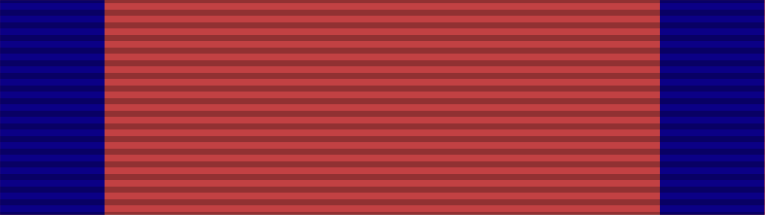
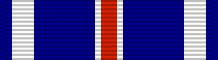
- Died
- 8 January 1945
- Fate
- Killed in action
Biography
Wing Commander Norman John Starr (service number 37834) was a Royal Air Force pilot who flew de Havilland Mosquito night-intruders with No. 605 Squadron, attacking enemy airfields and later operating against the V-1 flying bombs launched at Britain. For his work on these operations he was awarded the Distinguished Flying Cross and a Bar to it, the Bar being announced in the London Gazette of 17 November 1944 (Issue 36805, page 5341), where he is listed as “Norman John Starr, D.F.C. (37834), R.A.F.O., 605 Sqn.” By early 1945 he was commanding No. 276 (Air Sea Rescue) Squadron, based at the advanced landing ground B.83 at Knokke-le-Zoute in liberated Belgium. He was due to be married on 9 January 1945, and on 8 January he took off in an Avro Anson (MG552) to carry three fellow officers across to England for the wedding; the aircraft was brought down by anti-aircraft fire from the German-held, still-besieged port of Dunkirk, and all four men aboard were killed. Starr, aged in his twenties, is buried with his companions in Dunkirk Town Cemetery in northern France (Plot 2, Row 5, Collective Grave 22–23). (Note: the available sources document a DFC and Bar rather than a DSO; the 17 November 1944 Gazette reference announces the Bar to his DFC.)
Burial / commemoration
- Cemetery
- Dunkirk Town Cemetery, France
Operations on this date. One raid in this archive was flown on the night of 8 January 1945: Munich. (Cross-reference by date — not in itself confirmation this airman flew it.)
Timeline
-
17 November 1944
Gazetted: DSO
Distinguished Service Order -
17 November 1944
Gazetted: DFC
Distinguished Flying Cross - 8 January 1945 Died
Awards
-
Distinguished Service Order (DSO) — gazetted 17 November 1944
-
Distinguished Flying Cross (DFC) — gazetted 17 November 1944