
RAF Binbrook
England — County: Lincolnshire
ⓘ licence & credit
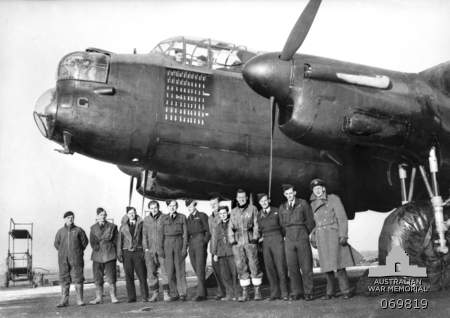
Royal Australian Air Force official photograph, December 1943 (AWM 069819): air and ground crews of 'G for George', Avro Lancaster of No. 460 Squadron RAAF, at RAF Binbrook (via Wikimedia Commons, Public domain)About
RAF Binbrook stands on the chalk uplands of the Lincolnshire Wolds, some 373 feet above sea level on ground that gave its bomber squadrons a useful margin over the fog and flood that plagued the lower fenland airfields to the south. The station opened on 27 June 1940 as a grass-surfaced Expansion Scheme airfield, still unfinished when its first two units, Nos. 12 and 142 Squadrons, moved in within a week of opening. Both squadrons brought Fairey Battles, the obsolescent light bomber that had been butchered over France that May; they re-equipped with Vickers Wellingtons during the autumn and from Binbrook took the new aircraft on the long, often costly night raids of the early bomber offensive.
The airfield was closed for most of 1942 while three concrete runways were laid, and reopened in May 1943 under No. 1 Group of Bomber Command. Its principal wartime tenant was No. 460 Squadron RAAF, an Australian-manned Lancaster unit which arrived that month and remained at Binbrook until July 1945. Over two years of operations the squadron flew more sorties and dropped a greater tonnage of bombs than any other unit in Bomber Command, at a cost of 188 aircraft and 1,018 men killed on operations. One of its surviving Lancasters, W4783 “G for George”, was flown home to Australia in 1944 and is now displayed at the Australian War Memorial in Canberra.
After the war Binbrook continued as a heavy-bomber station, passing through Avro Lincolns with Nos. IX, 12, 101 and 617 Squadrons and then English Electric Canberras during the 1950s. A long rebuild between 1960 and 1962 transferred the station to Fighter Command, and from 1965 it became the home of the RAF’s English Electric Lightning force. Nos. 5 and 11 Squadrons flew the supersonic interceptor from Binbrook for more than twenty years, scrambling routinely against Soviet maritime patrol aircraft probing the North Sea air-defence region. When the Lightning was finally retired in April 1988 the two squadrons converted to the Tornado F.3 and moved away.
The station served briefly as a relief landing ground for Scampton before formally closing in the summer of 1992, and the control tower was pulled down in 1995. Most of the airfield has since reverted to arable farmland, though the runway pattern is still visible from the air; the wartime C-Type hangars and technical site survive as an industrial estate, and the former married quarters were rebuilt as the small civilian village of Brookenby. A memorial in Binbrook village commemorates the airmen who flew from the ridge and did not return.
Sources: This page was compiled from publicly available historical sources, including Airfields Google Sheet (curated), Airfields of Britain Conservation Trust — Binbrook, Bomber County Aviation Resource — Binbrook airfield history and Wikipedia: RAF Binbrook. The text is original and has been written from factual source material; no source text has been copied unless specifically quoted and attributed.
Photographs
ⓘ licence & credit
Chris / CC BY-SA 2.0, via Wikimedia Commons — https://commons.wikimedia.org/wiki/File:Binbrook_airfield_-_geograph.org.uk_-_3008639.jpgView source & full licence →ⓘ licence & credit
Colin Smith / CC BY-SA 2.0, via Wikimedia Commons — https://commons.wikimedia.org/wiki/File:Binbrook_-_Former_Airfield_-_geograph.org.uk_-_8030958.jpgView source & full licence →ⓘ licence & credit
Chris / CC BY-SA 2.0, via Wikimedia Commons — https://commons.wikimedia.org/wiki/File:Airfield_buildings,_former_RAF_Binbrook,_in_2009_-_geograph.org.uk_-_2968588.jpgView source & full licence →ⓘ licence & credit
Jon McGuinness / CC BY-SA 2.0, via Wikimedia Commons — https://commons.wikimedia.org/wiki/File:A_building_at_the_former_RAF_Binbrook_-_geograph.org.uk_-_563377.jpgView source & full licence →ⓘ licence & credit
Ian S / CC BY-SA 2.0, via Wikimedia Commons — https://commons.wikimedia.org/wiki/File:460_Squadron_memorial_at_the_former_RAF_Binbrook_-_geograph.org.uk_-_5804782.jpgView source & full licence →Home to
- No. 460 Squadron — 1 Group
People connected to this base
27 persons cross-referenced to this airfield — through a posting here, a squadron based here, or aircrew who flew from it.
| Name | Rank | Connection | Dates |
|---|---|---|---|
| Anderson, Peter Robert | Pilot Officer | Aircrew (squadron based here) | — |
| Beaumont, John Edward | Flying Officer | Aircrew (squadron based here) | — |
| Chadwick-bates, Arthur George Jackson | Pilot Officer | Aircrew (squadron based here) | — |
| Dawson, Tom | Flight Sergeant | Aircrew (squadron based here) | — |
| Dockery, Graeme Mark | Flight Sergeant | Aircrew (squadron based here) | — |
| Downing, Jeffrey John | Flying Officer | Aircrew (squadron based here) | — |
| Green, Kenneth Edwin | Sergeant | Aircrew (squadron based here) | — |
| Hargreaves, Charles Haley | Flight Sergeant | Aircrew (squadron based here) | — |
| Howarth, John | Flying Officer | Aircrew (squadron based here) | — |
| Johnson, G P | Sergeant | Aircrew (squadron based here) | — |
| Jones, R R | Sergeant | Aircrew (squadron based here) | — |
| Jones, Glynn | Sergeant | Aircrew (squadron based here) | — |
| Lax, Douglas Graham | Sergeant | Aircrew (squadron based here) | — |
| Leggett, Alfred Edward | Sergeant | Aircrew (squadron based here) | — |
| McCleery, Ronald James | Pilot Officer | Aircrew (squadron based here) | — |
| Miller, Richard Albert George | Pilot Officer | Aircrew (squadron based here) | — |
| Moody, George David | Warrant Officer | Aircrew (squadron based here) | — |
| Nesbit-bell, Frederick Albert Cecil | Flight Sergeant | Aircrew (squadron based here) | — |
| Parmenter, Richard Sydney | Sergeant | Aircrew (squadron based here) | — |
| Pitfield, Albert Stanley | Sergeant | Aircrew (squadron based here) | — |
| Pope, Rhodric Leslie | Flight Sergeant | Aircrew (squadron based here) | — |
| Robinson, Anthony Gatward | Flight Sergeant | Aircrew (squadron based here) | — |
| Siddall, Donald Frank | Sergeant | Aircrew (squadron based here) | — |
| Spargo, William Henry | Flight Sergeant | Aircrew (squadron based here) | — |
| Thomson, Jack Hamilton | Pilot Officer | Aircrew (squadron based here) | — |
| Utz, Eric Arthur Gibson | Squadron Leader | Aircrew (squadron based here) | — |
| Woods, R L | Sergeant | Aircrew (squadron based here) | — |