
Vickers Wellington
Medium bomber · Vickers-Armstrongs · United Kingdom
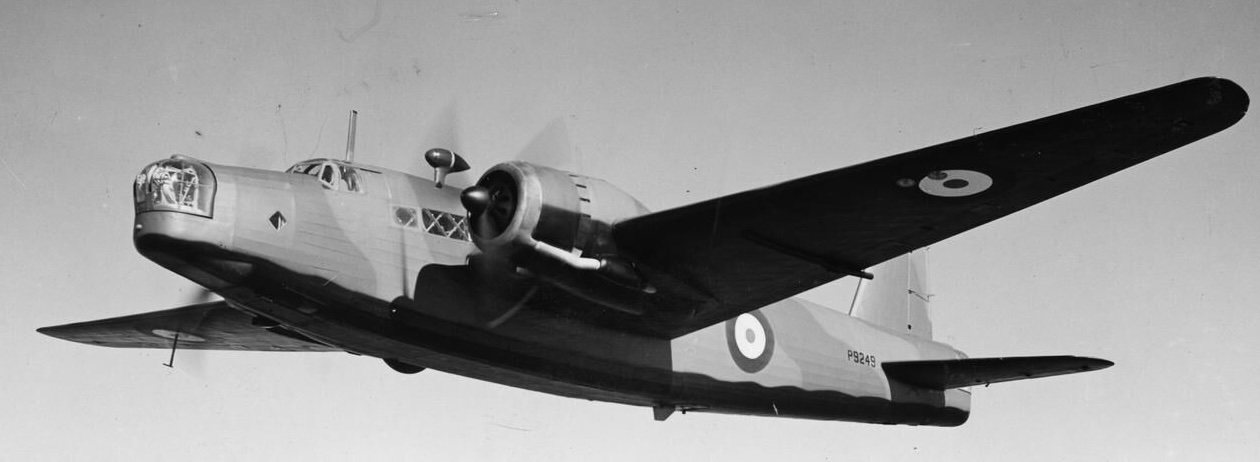
ⓘ licence & credit
Photographer not identified, so UK Copyright contended to have lapsed 50 years after publication. (via Wikimedia Commons, Public domain)| Typical crew | 6 |
|---|---|
| Engines | 2 × Bristol Pegasus or Hercules |
| First flight | 1936 |
| Number built | 11,461 |
Photographs
ⓘ licence & credit
Paul Nash / Public domain, via Wikimedia Commons — https://commons.wikimedia.org/wiki/File:Vickers_Wellington_(Paul_Nash).jpgView source & full licence →ⓘ licence & credit
neznámý (unknown) / Public domain, via Wikimedia Commons — https://commons.wikimedia.org/wiki/File:Vickers_Wellington_(K4049)_a_Walter_Pegas_X_(2x).jpgView source & full licence →ⓘ licence & credit
Royal Air Force official photographer / Public domain, via Wikimedia Commons — https://commons.wikimedia.org/wiki/File:U-boat_Warfare_1939-1945_C3780.jpgView source & full licence →ⓘ licence & credit
Bob Adams from George, South Africa / CC BY-SA 2.0, via Wikimedia Commons — https://commons.wikimedia.org/wiki/File:Sil-o-et_2_(14459882812).jpgView source & full licence →ⓘ licence & credit
Forward (Fg Off), Royal Air Force official photographer / Public domain, via Wikimedia Commons — https://commons.wikimedia.org/wiki/File:Royal_Air_Force_Bomber_Command,_1942-1945._CH17883.jpgView source & full licence →ⓘ licence & credit
No. 1 Camouflage Unit / Public domain, via Wikimedia Commons — https://commons.wikimedia.org/wiki/File:RAF_Swinderby_aerial_photograph_April_1941_IWM_HU_93063.jpgView source & full licence →ⓘ licence & credit
Goodchild A (F/O), Royal Air Force official photographer / Public domain, via Wikimedia Commons — https://commons.wikimedia.org/wiki/File:RAF_Hullavington_-_Royal_Air_Force_Flying_Training_Command,_1940-1945._CH11722.jpgView source & full licence →ⓘ licence & credit
K. Kobrzyński, K. Koszewski, T. Malinowski, J. Malujdy, ze zbiorów (from collection of): Komisja Historyczna Rady Seniorów Aeroklubu PRL, Muzeum Lotnictwa i Astronautyki w Krakowie, Ośrodek Postępu Technicznego NOT, Wojskowa Agencja Fotograficzna, "Skrzydlata Polska", J. Dembowski, W. Kisielewski, JView source & full licence →ⓘ licence & credit
Unknown authorUnknown author / Public domain, via Wikimedia Commons — https://commons.wikimedia.org/wiki/File:Plate,_Wellington_Bomber_EPH5316.jpgView source & full licence →ⓘ licence & credit
Hugos84 / CC BY-SA 4.0, via Wikimedia Commons — https://commons.wikimedia.org/wiki/File:Ji%C5%99%C3%AD_F%C3%ADna_-_Wellington_KX-P.jpgView source & full licence →ⓘ licence & credit
Royal Air Force official photographer / Public domain, via Wikimedia Commons — https://commons.wikimedia.org/wiki/File:Castelnuovo_-_Royal_Air_Force-_Italy,_1942-1945._C3813.jpgView source & full licence →ⓘ licence & credit
Daventry B J (Mr), Royal Air Force official photographer / Public domain, via Wikimedia Commons — https://commons.wikimedia.org/wiki/File:Air_Ministry_Second_World_War_Official_Collection_CH1422.jpgView source & full licence →ⓘ licence & credit
not stated / Public domain, via Wikimedia Commons — https://commons.wikimedia.org/wiki/File:455_Squadron_RAAF_Hampdens_at_RAF_Wigsley_WWII_AWM_SUK10371.jpgView source & full licence →ⓘ licence & credit
not stated / Public domain, via Wikimedia Commons — https://commons.wikimedia.org/wiki/File:455_Squadron_RAAF_Hampden_at_RAF_Wigsley_circa_1942_AWM_SUK10370.jpgView source & full licence →ⓘ licence & credit
No. 40 Squadron RAF / Public domain, via Wikimedia Commons — https://commons.wikimedia.org/wiki/File:40_Squadron_RAF_Wellingtons_bombing_Reggio_di_Calabria_1943_IWM_C_3639.jpgView source & full licence →ⓘ licence & credit
D. MOGG / Public domain, via Wikimedia Commons — https://commons.wikimedia.org/wiki/File:37_Squadron_RAF_Wellington_Middle_East_1942_AWM_P00809.003.jpgView source & full licence →About
The Vickers Wellington was the backbone of Bomber Command in the war’s early years and the only British bomber to remain in production throughout the conflict. Designed at Brooklands by Rex Pierson, its defining feature was the geodetic fuselage devised by Barnes Wallis — a metal lattice of duralumin members covered in doped fabric. The structure was extraordinarily tough: a Wellington could lose whole sections of framework to flak and still fly home.
The twin-engined “Wimpy” first used Bristol Pegasus radials, with the later Mk III adopting the more powerful Bristol Hercules. It bore much of the night offensive until the four-engined heavies took over, flying more than 47,000 Bomber Command sorties, and went on to serve widely with Coastal Command and overseas. Roughly 11,400 were built — more than any other British bomber — and surviving examples can be seen at Brooklands and the RAF Museum.
Sources: This page was compiled from publicly available historical sources, including Vickers Wellington — RAF Museum (Midlands) and Vickers Wellington — Wikipedia. The text is original and has been written from factual source material; no source text has been copied unless specifically quoted and attributed.
Engines
- Bristol Hercules — 14-cylinder two-row air-cooled sleeve-valve radial, 38.7 litres
- Bristol Pegasus — 9-cylinder single-row air-cooled radial
Airframes in this database
| Serial | Code | Squadron | Fate |
|---|---|---|---|
| BJ919 | OW | 426 | Lost on operations |
| BJ973 | AS-J | 166 | Lost on operations |
| HE531 | HD | 466 | Written off (non-op) |
| HE865 | — | — | Written off (non-op) |
| L4268 | — | 9 | Lost on operations |
| LN281 | — | — | Written off (non-op) |
| LN445 | — | — | Written off (non-op) |
| LN553 | — | — | Written off (non-op) |
| MF116 | — | — | Written off (non-op) |
| MF200 | — | — | Written off (non-op) |
| MF509 | — | — | Written off (non-op) |
| N2980 | R | 149 | Written off (non-op) |
| W5356 | — | 12 | Lost on operations |
| X9764 | NZ | 304 | Lost on operations |