
RAF Marham
England — County: Norfolk
ⓘ licence & credit
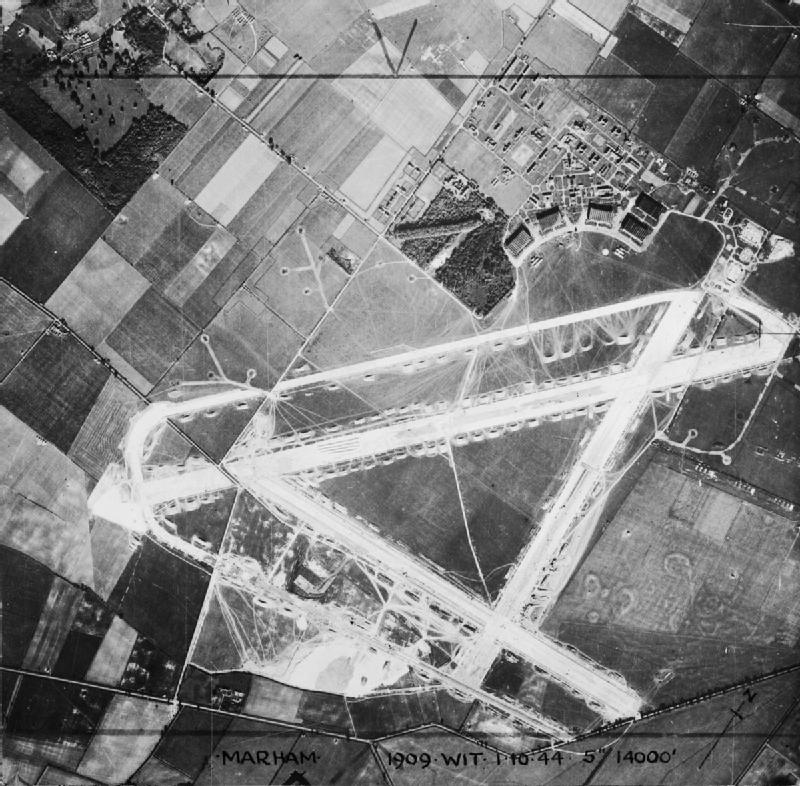
Royal Air Force official photographer (RAF Wittering), 1944. Aerial photograph from 14,000 ft, a few months after RAF Marham's upgrade to concrete runways in April 1944. IWM C 5469 (via Wikimedia Commons, Public domain)About
RAF Marham occupies a low gravel plateau in west Norfolk, between King’s Lynn and Swaffham, on a site first cleared for aircraft in August 1916 as a night landing ground for the Royal Flying Corps. No. 51 Squadron moved in the following month to fly home-defence patrols against Zeppelin and Gotha raids tracking inland over the Wash, and No. 191 (Night) Training Squadron formed there in November 1917 to feed crews into the same fight. When No. 51 departed in May 1919 the field was given up to agriculture, and it stayed quiet for almost two decades.
Marham was brought back into service on 1 April 1937 as part of the Expansion Scheme, with No. 38 Squadron arriving a month later flying the lumbering Fairey Hendon — the RAF’s last fabric-covered heavy bomber — and No. 115 Squadron reforming alongside it on Handley Page Harrows. By the outbreak of war both units had re-equipped with Vickers Wellingtons and Marham had become a 3 Group bomber station, sending crews on the early daylight sweeps over the German Bight and then on the long night campaign against Ruhr and Rhineland targets. Short Stirlings replaced the Wellingtons during 1941 and 1942, but Marham’s defining contribution came after No. 105 Squadron arrived with the de Havilland Mosquito B.IV: joined by No. 139 Squadron, the station became one of the cradles of the Light Night Striking Force, the high-altitude pathfinder and nuisance-raid arm that flew unarmed Mosquitos over Berlin night after night. On 30 January 1943 three of its aircraft were timed to put bombs through the roof of the Haus des Rundfunks while Hermann Goering was on the air. The station closed in March 1944 for the laying of concrete runways and reopened with No. 218 Squadron in residence.
The Cold War turned Marham into one of the RAF’s two main strategic bomber bases. From 1950 it operated seventy borrowed Boeing Washington B.1s — Lend-Lease B-29s — before passing to the V-force, flying Vickers Valiants and then Handley Page Victors in both bomber and tanker roles. Tornado GR1s replaced the Victors from April 1982, and on 1 January 1983 No. 617 Squadron — the original Dambusters — reformed at Marham on the type; the squadron and the station went to war together over Iraq, the Balkans, Afghanistan and Libya, the last Tornado sortie flying on 14 March 2019.
Marham today is the home of the UK’s Lightning Force. No. 617 Squadron reformed for a third time on 11 January 2019, this time on the F-35B Lightning II, with No. 207 Squadron standing up as the type’s operational conversion unit later that summer. The station remains an active front-line RAF base.
Sources: This page was compiled from publicly available historical sources, including Airfields Google Sheet (curated) and Wikipedia: RAF Marham. The text is original and has been written from factual source material; no source text has been copied unless specifically quoted and attributed.
Photographs
ⓘ licence & credit
Royal Air Force official photographer, Forward (F/O) / Public domain, via Wikimedia Commons — https://commons.wikimedia.org/wiki/File:Royal_Air_Force_Bomber_Command,_1942-1945._CH6272.jpgView source & full licence →ⓘ licence & credit
Forward (F/O), Royal Air Force official photographer / Public domain, via Wikimedia Commons — https://commons.wikimedia.org/wiki/File:Royal_Air_Force_Bomber_Command,_1942-1945._CH6276.jpgView source & full licence →ⓘ licence & credit
RAF Wittering, Royal Air Force official photographer / Public domain, via Wikimedia Commons — https://commons.wikimedia.org/wiki/File:RAF_Marham_aerial_photograph_1944_IWM_C_5469.jpgView source & full licence →Home to
- No. 139 Squadron (Jamaica) — 8 Group
People connected to this base
1 person cross-referenced to this airfield — through a posting here, a squadron based here, or aircrew who flew from it.
| Name | Rank | Connection | Dates |
|---|---|---|---|
| McPherson, Andrew | Flying Officer | Squadron served here | — |